

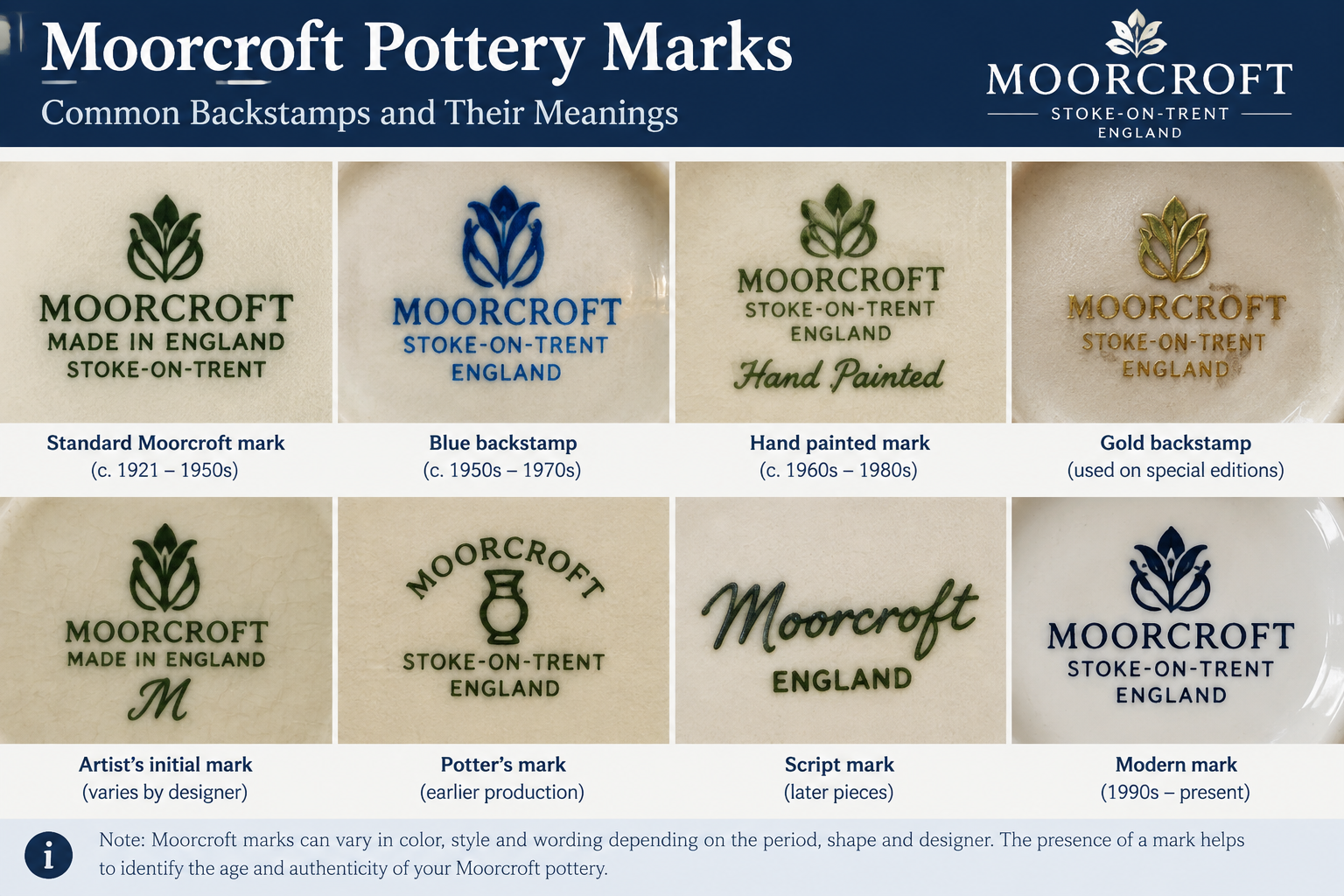
w moorcroft pottery marks: The Complete Guide to Identification, Dating, and Value
Understanding w moorcroft pottery marks is essential for collectors, antique dealers, and anyone trying to authenticate a piece of Moorcroft pottery. The marks found on the underside of Moorcroft ceramics can reveal the maker, production period, designer, and sometimes the rarity of a piece. Whether you have inherited a vase, discovered a bowl at an auction, or are building a collection, learning how to read these marks helps you separate valuable originals from later reproductions.
Moorcroft pottery has a long history of distinctive signatures, impressed stamps, paper labels, and factory marks. Each variation provides clues about when and where a piece was produced.
Quick Facts About Moorcroft Pottery Marks
| Feature | What It Can Tell You |
|---|---|
| Signature or impressed mark | Identifies the maker or designer |
| Factory stamp | Indicates production era |
| Paper label | Helps date earlier pieces |
| Designer initials | May identify limited collections |
| Shape numbers | Connect to catalogues and production records |
| Registration marks | Provide historical dating clues |
Why Moorcroft Pottery Marks Matter to Collectors
Moorcroft pottery is highly regarded because of its artistic designs, hand-crafted production methods, and strong connection to British studio pottery history. Marks are one of the most reliable tools for confirming authenticity.
A genuine mark can help answer important questions:
- Is the piece authentic Moorcroft?
- Who designed the pattern?
- When was it made?
- Is it from a desirable collecting period?
- Does it have investment value?
However, marks should not be viewed in isolation. The design, glaze, craftsmanship, condition, and provenance all contribute to a piece’s overall importance.
The History Behind Moorcroft Marks
Early Moorcroft Marks Under William Moorcroft
The earliest Moorcroft pieces were created by William Moorcroft while he worked at Macintyre & Co. before establishing his own pottery identity.
Early pieces may feature:
- Impressed factory marks
- Hand-painted signatures
- Macintyre references
- Design numbers
These early examples are often among the most sought-after by collectors because of their rarity and historical importance.
The Moorcroft Pottery Era
After William Moorcroft developed his own pottery business, marks became more closely associated with the Moorcroft name. Later pieces often included clearer factory identification, allowing collectors to date them more easily.
Different decades introduced changes in:
- Logo styles
- Signature placement
- Labels
- Factory wording
- Designer references
How to Identify Different Moorcroft Pottery Marks
1. Handwritten Signatures
Many early Moorcroft pieces feature handwritten signatures, usually painted beneath the glaze or added during production.
Important details to examine include:
- The style of handwriting
- Location of the signature
- Whether the signature matches the production period
- Whether it appears consistent with known examples
A signature alone does not guarantee authenticity, but it can provide valuable evidence.
2. Impressed Marks
Impressed marks are pressed into the clay before firing. They are often subtle and may become difficult to read because of glaze coverage.
Look for:
- The Moorcroft name
- Factory references
- Numbers or codes
- Registration symbols
Use a strong light source and avoid cleaning aggressively, as removing original surface details can reduce value.
3. Paper Labels and Stickers
Paper labels can be particularly useful because styles changed over time. Older labels may show different wording, logos, or locations than modern examples.
Collectors often compare:
- Font style
- Label shape
- Condition
- Placement
A surviving original label can strengthen the identification of a piece.
Moorcroft Marks by Period
| Period | Typical Mark Characteristics |
|---|---|
| Late 19th century | Macintyre connections, early signatures, impressed details |
| Early 20th century | William Moorcroft signatures and distinctive factory marks |
| Mid-century | More standardized Moorcroft identification marks |
| Late 20th century | Clearer logos, labels, and designer references |
| Modern production | Consistent factory branding and collection details |
Common Mistakes When Reading Moorcroft Marks
Mistake 1: Assuming Every Signature Is Original
Some pieces may have added signatures, repaired marks, or unclear markings. Always consider the complete object rather than one identifying feature.
Mistake 2: Ignoring the Pattern Design
Moorcroft designs often provide important dating clues. A mark combined with a known pattern can create a much stronger identification.
Mistake 3: Cleaning Marks Too Aggressively
Collectors sometimes damage valuable pieces by scrubbing bases to reveal markings. Gentle examination is safer than harsh cleaning methods.
Mistake 4: Confusing Modern and Antique Pieces
Moorcroft continues to produce ceramics today. A newer piece may be authentic but have a different market value compared with an early example.
How to Authenticate a Moorcroft Piece Step by Step
Follow this process when examining a piece:
- Photograph the entire item
- Capture the front, base, and any labels.
- Inspect the mark carefully
- Record every visible word, symbol, and number.
- Identify the design
- Compare the pattern with known Moorcroft collections.
- Check craftsmanship
- Look at glazing, painting quality, and construction.
- Research comparable examples
- Compare auction results and collector references.
- Seek expert evaluation if needed
- Particularly for rare or early pieces.
Factors That Influence Moorcroft Pottery Value
Marks help identify a piece, but value depends on several factors.
Age
Older pieces, especially those connected to William Moorcroft’s early career, can attract strong collector interest.
Rarity
Limited patterns, unusual forms, and discontinued designs often command higher prices.
Condition
Collectors generally prefer pieces with:
- No cracks
- No chips
- Original glaze
- Clear markings
Artist and Designer Importance
Certain designers and periods are more desirable because of their influence on Moorcroft’s artistic development.
Where to Find Reliable Moorcroft Mark Information
For accurate identification, collectors commonly use:
- Specialist Moorcroft reference books
- Museum collections
- Established antique dealers
- Auction house archives
- Experienced collector communities
Avoid relying on a single online image comparison. Many designs and marks have subtle variations.
Expert Tips for Collectors
Experienced collectors often look beyond the obvious signature. The relationship between the mark, design, shape, and production history provides the strongest authentication evidence.
Useful habits include:
- Keeping detailed records of purchases
- Photographing marks before storage
- Comparing examples from reputable sources
- Learning major Moorcroft design periods
- Tracking auction trends
Frequently Asked Questions About Moorcroft Marks
Are all Moorcroft pieces marked?
No. Some early pieces have limited markings, and some labels may have been lost over time. Lack of a visible mark does not automatically mean a piece is not genuine.
Can Moorcroft marks determine exact age?
Marks can narrow down the production period, but exact dating usually requires additional evidence such as pattern history, shape numbers, and provenance.
Are signed Moorcroft pieces more valuable?
Not always. A signature can increase interest, but collectors also consider rarity, condition, design, and historical importance.
How can I tell if my Moorcroft pottery is valuable?
Start by identifying the mark, pattern, age, and condition. A professional valuation may be worthwhile for unusual or early examples.
Conclusion
Learning to interpret w moorcroft pottery marks gives collectors a powerful method for identifying, dating, and appreciating Moorcroft ceramics. While marks provide essential clues, the most accurate evaluations combine signatures, factory details, design history, craftsmanship, and condition. By studying these features carefully, collectors can make more informed decisions and better understand the heritage behind each Moorcroft piece.
