

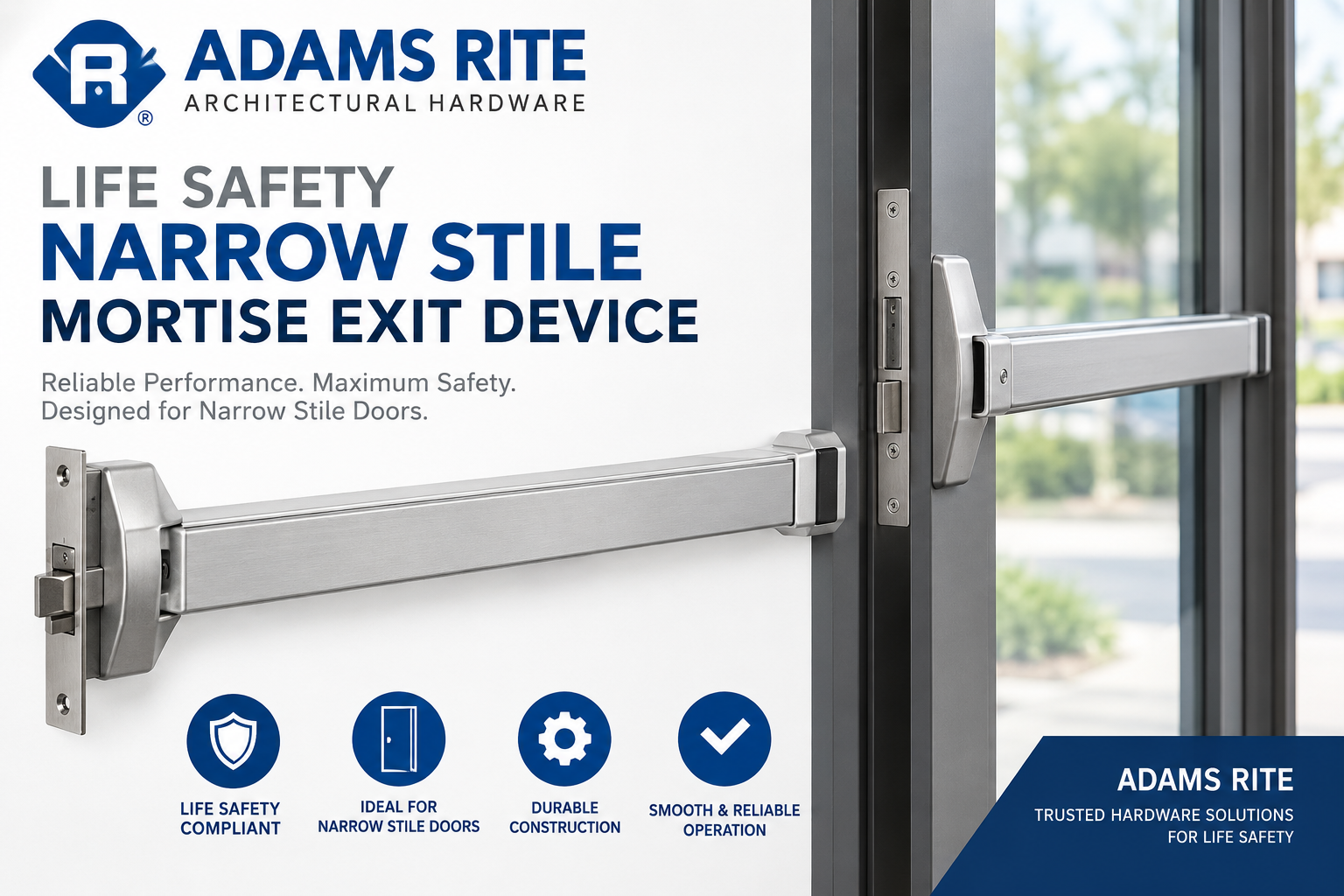
adams rite life safety narrow stile mortise exit device: 8400 Series Guide
The adams rite life safety narrow stile mortise exit device is best understood as the Adams Rite 8400 Series: a commercial panic-hardware solution engineered for narrow stile aluminum doors that need a mortise locking configuration.
For architects, locksmiths, glazing contractors, facility managers, and hardware buyers, the critical question is not simply whether the device fits the door. The real task is matching the correct backset, handing, door width, cylinder, trim, electrification options, and opening requirements before ordering or modifying the door.
Adams Rite identifies the 8400 Series as a life-safety mortise exit device for narrow stile aluminum applications and single-door openings. Current manufacturer literature lists UL 305 Panic Hardware and ANSI/BHMA A156.3 Grade 1 certification.
Quick Facts: Adams Rite 8400 Series
| Specification | 8400 Series Detail |
|---|---|
| Device type | Life-safety mortise exit device |
| Primary application | Narrow stile aluminum doors |
| Door configuration | Single doors |
| Minimum stile width | 2 in. / 50.8 mm |
| Standard door thickness | 1-3/4 in. / 44.5 mm |
| Available backsets | 31/32 in., 1-1/8 in., 1-1/2 in. |
| Standard opening widths | 30, 36, 42, and 48 in. |
| Standard dogging | Hex-key dogging |
| Optional dogging | Cylinder dogging |
| Cylinder type | Mortise cylinder with MS® cam |
| Standard certification | UL 305 Panic Hardware |
| Performance classification | ANSI/BHMA A156.3 Grade 1 |
| Electrified options | Latch retraction, motorized latch retraction, monitoring, alarm options depending on configuration |
Manufacturer literature states that standard-width bars can be field cut to the next smaller supported opening size and that the device fits narrow, medium, and wide stile aluminum doors with a minimum 2-inch stile.
What Is the Adams Rite 8400 Narrow Stile Mortise Exit Device?
The 8400 Series combines a horizontal push bar with a mortise locking mechanism installed within the door stile. Pressing the exit device retracts the latch so occupants can exit without first operating a key, thumbturn, or separate locking control.
This configuration is particularly useful on commercial aluminum entrances where conventional cylindrical or full-size mortise panic hardware may be physically too large for the stile.
Unlike a rim exit device, where the latch mechanism is surface-mounted at the edge of the opening, a mortise exit device incorporates the locking mechanism into the door.
Why Mortise Locking Matters on Narrow Stile Doors
Narrow stile aluminum doors leave limited real estate for lock hardware. The mortise configuration allows the locking mechanism to fit into this constrained profile while maintaining the clean appearance typically expected on storefront and architectural aluminum entrances.
The 8400 Series is specifically designed around this environment rather than being a standard panic device adapted to a narrow door.
Adams Rite lists three backset choices—31/32 inch, 1-1/8 inch, and 1-1/2 inch—and notes compatibility with the standard preparation used for its 4900 Heavy Duty Deadlatch.
Where the Adams Rite 8400 Series Makes Sense
The adams rite life safety narrow stile mortise exit device is most appropriate when several conditions occur together:
- The door is a narrow stile aluminum swinging door.
- The opening requires panic hardware or a life-safety exit device.
- A mortise locking solution is preferred or already accommodated by the door preparation.
- The opening is a single-door configuration.
- Security from the exterior must coexist with free egress from the interior.
- The project calls for commercial-grade hardware suited to frequent use.
Typical environments can include retail storefronts, offices, commercial buildings, educational facilities, tenant entrances, and other occupied spaces using aluminum-framed doors.
Actual code suitability always depends on the occupancy, door assembly, applicable building and fire codes, local amendments, and the authority having jurisdiction.
The Difference Between Life-Safety and Fire-Rated Hardware
One of the most expensive specification mistakes is treating life-safety, panic, and fire exit hardware as interchangeable terms.
They are not.
The Adams Rite product lineup identifies the 8400 as a life-safety mortise exit device. Adams Rite separately identifies fire-rated models in portions of its exit-device range.
That distinction matters because a door requiring listed fire exit hardware may have different requirements for positive latching, dogging, labeling, door construction, installation, and compatible components.
Do Not Assume UL 305 Means the Opening Is Fire Rated
UL 305 addresses panic hardware. It should not be interpreted by itself as proof that a complete opening satisfies a required fire-door rating.
Before specifying an 8400 Series device on a rated opening, verify:
- The door and frame labels
- The required fire rating
- Hardware listings
- Whether dogging is permitted
- Approved strikes and trim
- Electrification requirements
- Local code requirements
- Requirements imposed by the authority having jurisdiction
For a life-safety opening, hardware selection should begin with the opening’s code requirements—not with the hardware already on the shelf.
8400 Series Dimensions and Door Compatibility
Dimensional compatibility is one of the first things to establish before ordering.
Minimum Stile Width
The manufacturer lists a 2-inch minimum stile width for the 8400 Series. It can therefore fit narrow, medium, and wide stile aluminum applications when the remaining door dimensions and preparation are compatible.
Do not judge stile compatibility from the visible face width alone. Existing glass stops, reinforcement, internal door construction, previous lock preparations, and backset can affect whether the installation is practical.
Door Thickness
Standard configuration is intended for a 1-3/4-inch door thickness.
Manufacturer literature also references separate solutions for thicker and thermal doors, so unusual aluminum constructions should be identified before the device is ordered.
Push Bar Length
Standard sizes are dimensioned for:
- 30-inch openings
- 36-inch openings
- 42-inch openings
- 48-inch openings
The manufacturer permits standard-width bars to be field cut to the next smaller supported opening width.
That does not mean every device can be shortened arbitrarily. Confirm the cut-down allowance for the exact ordered configuration before modifying the bar.
Choosing the Correct Backset
Backset is one of the most important ordering variables for narrow stile hardware.
The Adams Rite 8400 Series is available with:
- 31/32 in. (24.6 mm)
- 1-1/8 in. (28.6 mm)
- 1-1/2 in. (38.1 mm)
These choices allow the device to accommodate different aluminum door profiles and existing preparations.
Never Order Backset From Memory
Two storefront doors that look identical from six feet away may have different stile depths, lock preparations, or cylinder locations.
Before ordering, measure the actual door and identify the existing hardware preparation.
For replacement projects, verify the model stamped on the existing hardware whenever possible. Measuring the old lock body alone is less reliable than combining physical measurements with positive product identification.
Handing and Bevel: A Small Detail With Big Consequences
The 8400 Series requires the appropriate handing and bevel to be specified when applicable.
Handing errors are especially common when hardware is ordered from photographs or when “left” and “right” are used without an agreed reference point.
Record the opening using standard door-hardware handing terminology rather than informal descriptions.
Before purchase, document:
- Which side of the door the hinges are on.
- Which direction the door swings.
- Whether the opening is LH, RH, LHR, or RHR as required by the supplier’s nomenclature.
- The door-edge bevel or faceplate requirement.
- Whether existing trim changes the required configuration.
A few minutes spent documenting handing can prevent a costly return or field modification.
Cylinder Requirements
The 8400 Series uses a mortise cylinder rather than a rim cylinder for the applicable keyed functions.
Manufacturer literature specifies a standard 1-5/32-inch diameter mortise cylinder with an MS® cam, commonly represented by the Adams Rite 4036 Mortise Cylinder family. Cylinder lengths from approximately 1 inch to 1-1/4 inches are accommodated depending on the application.
Why the Cam Matters
A mortise cylinder can physically fit a preparation yet fail to operate the lock correctly if the cam is wrong.
When replacing cylinders, verify:
- Cylinder diameter
- Cylinder length
- Cam configuration
- Keyway
- Keying requirements
- Finish
- Exterior trim function
This is particularly important when integrating the exit device into an existing master-key system.
Exterior Trim and Entry Functions
An exit device controls egress from the secure side of the door, but most commercial entrances also need a defined method of entry from outside.
Depending on configuration, an exterior trim package can provide functions such as:
- Key-controlled entry
- Lever operation
- Night-latch operation
- Fixed-pull operation
- Electrically controlled entry
Adams Rite identifies compatible entry trim and cylinder configurations within its exit-device ecosystem.
The exterior function should be selected at the same time as the exit device. Treating trim as an afterthought is a common cause of incompatible cylinders, incorrect door preparation, and access-control complications.
Mechanical vs. Electrified 8400 Configurations
A basic mechanical exit device may be sufficient for a standalone door. Buildings with access control, scheduled unlocking, monitoring, or security management may need an electrified configuration.
Adams Rite offers mechanical and electrified options across its exit-device platform, including motorized latch retraction, electric latch retraction, monitoring, alarm functions, and cylinder dogging depending on the specific device configuration.
Motorized Latch Retraction
Motorized latch retraction can retract the latch electronically, allowing the door to function with an access-control or scheduled-unlock system while retaining mechanical egress.
This can be useful where a building automation or access-control system needs to change the door’s secure state during normal operations.
Electric Latch Retraction
Electric latch retraction serves a related purpose but has specific electrical and power-supply requirements.
Do not select electrification based only on voltage. Check the complete system, including:
- Power supply
- Current requirements
- Wire transfer
- Cable routing
- Access-control relay logic
- Request-to-exit requirements
- Monitoring needs
- Fail-safe/fail-secure behavior of associated components
Monitoring and Alarm Options
Monitoring can provide door-status or device-status information to another system. Alarm options may be useful where unauthorized egress needs to generate a local indication.
The exact signaling strategy should be developed with the security or access-control design rather than added after the door hardware has been installed.
Adams Rite 8400 vs. Other Narrow Stile Exit Devices
Choosing mortise hardware by habit can lead to unnecessary complexity. The door and opening conditions should determine the device type.
| Adams Rite Series | Latching Style | Typical Door/Application | Best Fit |
|---|---|---|---|
| 8400 | Mortise | Aluminum, single door | Narrow stile opening needing mortise locking |
| 8200 | Surface vertical rod | Aluminum | Two-point surface-mounted latching |
| 8600 | Concealed vertical rod | Aluminum | Two-point locking with concealed rods |
| 8800 | Rim/Starwheel | Aluminum | Surface rim device with interlocking latch |
Adams Rite describes the 8200 as a surface vertical rod device for aluminum stile applications, the 8600 as a concealed vertical rod device for aluminum applications, and the 8800 as a rim exit device using its Starwheel interlocking latching solution.
Choose the 8400 When:
- The project specifically needs mortise locking.
- The aluminum stile can accommodate the required preparation.
- The opening is a single door.
- Existing preparation favors an Adams Rite mortise/deadlatch footprint.
- A clean narrow-stile solution is important.
Consider a Rim Device When:
- Surface-mounted latching is preferable.
- The frame and strike configuration support it.
- Retrofitting a mortise lock would require excessive modification.
- The opening’s security strategy benefits from rim-style latching.
Consider Vertical Rod Hardware When:
- The opening needs top-and-bottom or multi-point latching.
- Door/frame conditions make single-point mortise latching unsuitable.
- The architectural design calls for concealed or surface vertical rods.
The best device is the one that matches the complete opening, not necessarily the one with the highest hardware grade or most features.
Installation Planning: What to Verify Before Drilling
A narrow stile aluminum door offers little room for error. An incorrectly positioned cutout can damage the stile, conflict with glass or reinforcement, or leave too little material for secure fastening.
Before modifying the door, verify the manufacturer’s current template and installation instructions for the exact model.
Pre-Installation Checklist
Confirm:
- Door width
- Door thickness
- Stile width
- Door handing
- Door bevel
- Backset
- Existing lock preparation
- Exit-device length
- Strike location
- Cylinder type and length
- Exterior trim function
- Finish
- Electrification package
- Wire-transfer method
- Power-supply compatibility
- Required code listings
The door should also swing freely and align correctly before the panic hardware is installed.
An exit device should not be used to compensate for a sagging door, twisted frame, misaligned pivot, or failing closer.
Common Installation and Specification Mistakes
1. Confusing the 8400 With a Rim Device
The 8400 is a mortise exit-device platform. Ordering rim strikes or rim-device accessories because the push bars look similar creates immediate compatibility problems.
2. Ignoring Backset
Backset is not a cosmetic option. It determines how the lock body relates to the stile and door edge.
Measure before ordering.
3. Assuming Every Narrow Stile Door Has the Same Prep
Aluminum storefront systems vary significantly by manufacturer, era, stile depth, reinforcement, and previously installed hardware.
A “standard storefront door” is not a sufficient specification.
4. Forgetting Handing
Handing and bevel should be confirmed before purchase. Do not rely solely on a photograph supplied by someone standing on an unknown side of the opening.
5. Ordering the Exit Device Without Trim or Cylinder
The push bar may be only one component of the complete operational package.
Determine outside entry requirements at the start.
6. Treating Electrification as a Hardware-Only Decision
Electrified exit hardware affects the power supply, cabling, transfer hardware, access-control panel, fire alarm interface, and sometimes the sequence of operations.
Coordinate it as a system.
7. Assuming Life-Safety Hardware Is Automatically Fire-Rated
The opening’s fire-rating requirement must be verified independently.
Do not substitute panic hardware for required fire exit hardware without confirming the applicable listing and code requirements.
8. Cutting the Push Bar Before Confirming Limits
The manufacturer permits certain field cut-downs, but modifications must remain within published limits.
Measure twice and verify the current cut-down instructions before cutting once.
Retrofit Considerations for Existing Adams Rite Hardware
The 8400 Series can be particularly attractive when replacing hardware on an aluminum door that already has compatible Adams Rite preparation.
Manufacturer documentation states that its backset configurations fit the standard cutout used for the Adams Rite 4900 Heavy Duty Deadlatch.
That can reduce fabrication compared with adapting a completely different hardware architecture.
However, never assume an existing Adams Rite lock automatically guarantees a direct retrofit. Older installations may have:
- Modified faceplates
- Enlarged cutouts
- Nonstandard reinforcement
- Aftermarket cylinders
- Improvised strikes
- Previous repair work
- Obsolete electrical modifications
Remove the existing hardware and inspect the opening before finalizing replacement hardware whenever project conditions allow.
Maintenance Tips for Long-Term Reliability
Commercial exit hardware is often operated hundreds of times per day. Preventive inspection is therefore more valuable than waiting for a complete failure.
Periodically check:
- Push-bar movement
- Positive latch engagement
- Strike alignment
- Mounting fasteners
- Door sag
- Closer operation
- Cylinder operation
- Exterior trim
- Wiring and power transfer on electrified models
- Any monitoring or alarm functions
The door should latch positively without requiring excessive force.
If pressing the bar feels unusually heavy, diagnose door alignment and latch/strike interaction before assuming the exit device itself has failed.
When Should an Existing 8400 Series Device Be Replaced?
Replacement may be appropriate when:
- The chassis or latch mechanism is badly worn.
- The bar has significant physical damage.
- Repairs have become repetitive.
- Required replacement parts are unavailable.
- The opening is being converted to access control.
- Door construction or occupancy requirements have changed.
- The existing configuration no longer satisfies the project specification.
If the problem is limited to a cylinder, trim component, strike alignment, or door adjustment, full device replacement may not be necessary.
Accurate diagnosis can substantially reduce both hardware cost and downtime.
How to Specify the Correct Adams Rite 8400 Configuration
A useful hardware request should contain more than “Adams Rite 8400 panic bar.”
Provide the supplier with:
- Series: 8400 Series mortise exit device
- Door material: Aluminum
- Door width: Exact opening/device size
- Door thickness: Including thermal or special construction
- Stile width: Measured dimension
- Backset: 31/32, 1-1/8, or 1-1/2 inch as applicable
- Handing: Confirmed handing and bevel
- Finish: Match existing or scheduled hardware
- Cylinder function: Required key operation
- Exterior trim: Lever, pull, keyed function, or other configuration
- Dogging: Hex key, cylinder, or project-specific requirement
- Electrification: Mechanical, latch retraction, monitoring, alarm, or other option
- Code requirement: Panic, life-safety, fire-rating, accessibility, or project specification
- Existing preparation: New installation or retrofit
This information gives the distributor or hardware consultant enough context to identify conflicts before material reaches the jobsite.
Frequently Asked Questions
What model is the Adams Rite life safety narrow stile mortise exit device?
The relevant U.S. product family is the Adams Rite 8400 Series Life-Safety Narrow Stile Mortise Exit Device, designed primarily for narrow stile aluminum single-door applications.
Is the Adams Rite 8400 a panic device?
Yes. Manufacturer literature lists the 8400 Series to UL 305 Panic Hardware.
Is the 8400 Series Grade 1?
Current manufacturer literature identifies the 8400 as meeting ANSI/BHMA A156.3 Grade 1.
What is the minimum stile width?
The published minimum is 2 inches (50.8 mm).
What backsets are available?
Published options are 31/32 inch, 1-1/8 inch, and 1-1/2 inch.
What door thickness does it fit?
The standard configuration is designed around a 1-3/4-inch door. Manufacturer literature also references separate kits or modifications for certain thicker or thermal doors.
What widths are offered?
The standard push-bar sizes are dimensioned for 30-, 36-, 42-, and 48-inch openings.
Can the bar be cut down?
Yes, within published limits. Adams Rite states that standard bars can be field cut to the next smaller opening width. Verify the current cut-down instructions for the exact device before modification.
What cylinder does the 8400 use?
Applicable keyed functions use a standard mortise cylinder with an MS® cam, such as the Adams Rite 4036 family.
Is the device handed?
Handing and bevel must be specified where applicable, so they should be confirmed before ordering.
Can the Adams Rite 8400 be electrified?
Yes. Adams Rite’s exit-device platform supports electrified functions including latch-retraction, motorized latch-retraction, monitoring, and alarm options depending on the selected configuration.
Is it suitable for double doors?
The manufacturer describes the 8400 Series as designed for single-door applications. For pairs of doors, another exit-device architecture may be more appropriate depending on the mullion, rods, frame, and required latching arrangement.
Final Buying Checklist
Before purchasing, make sure you can answer all of the following:
- Is the opening a single narrow stile aluminum door?
- Does the opening specifically need a mortise exit device?
- Is a 2-inch minimum stile available?
- What is the exact backset?
- What is the door thickness?
- What is the door width?
- What is the handing and bevel?
- What exterior entry function is needed?
- What mortise cylinder and keying are required?
- Is dogging permitted for this opening?
- Is electrification required?
- Does the device need to communicate with access control?
- Is the opening fire-rated?
- Have the latest manufacturer template and installation instructions been checked?
If any of those answers are unknown, resolve them before placing the order.
Conclusion
The adams rite life safety narrow stile mortise exit device is a specialized solution rather than a generic panic bar. The Adams Rite 8400 Series is designed around the dimensional constraints and locking requirements of narrow stile aluminum single doors, with multiple backsets, commercial-grade construction, mortise-cylinder compatibility, and mechanical or electrified options.
Its strongest advantage comes from specifying the complete opening correctly. Confirm stile width, backset, handing, door thickness, bar length, trim, cylinder, electrical requirements, and code conditions before ordering. When those details are coordinated correctly, the 8400 Series provides a clean, purpose-built approach to life-safety egress on commercial aluminum doors.
