

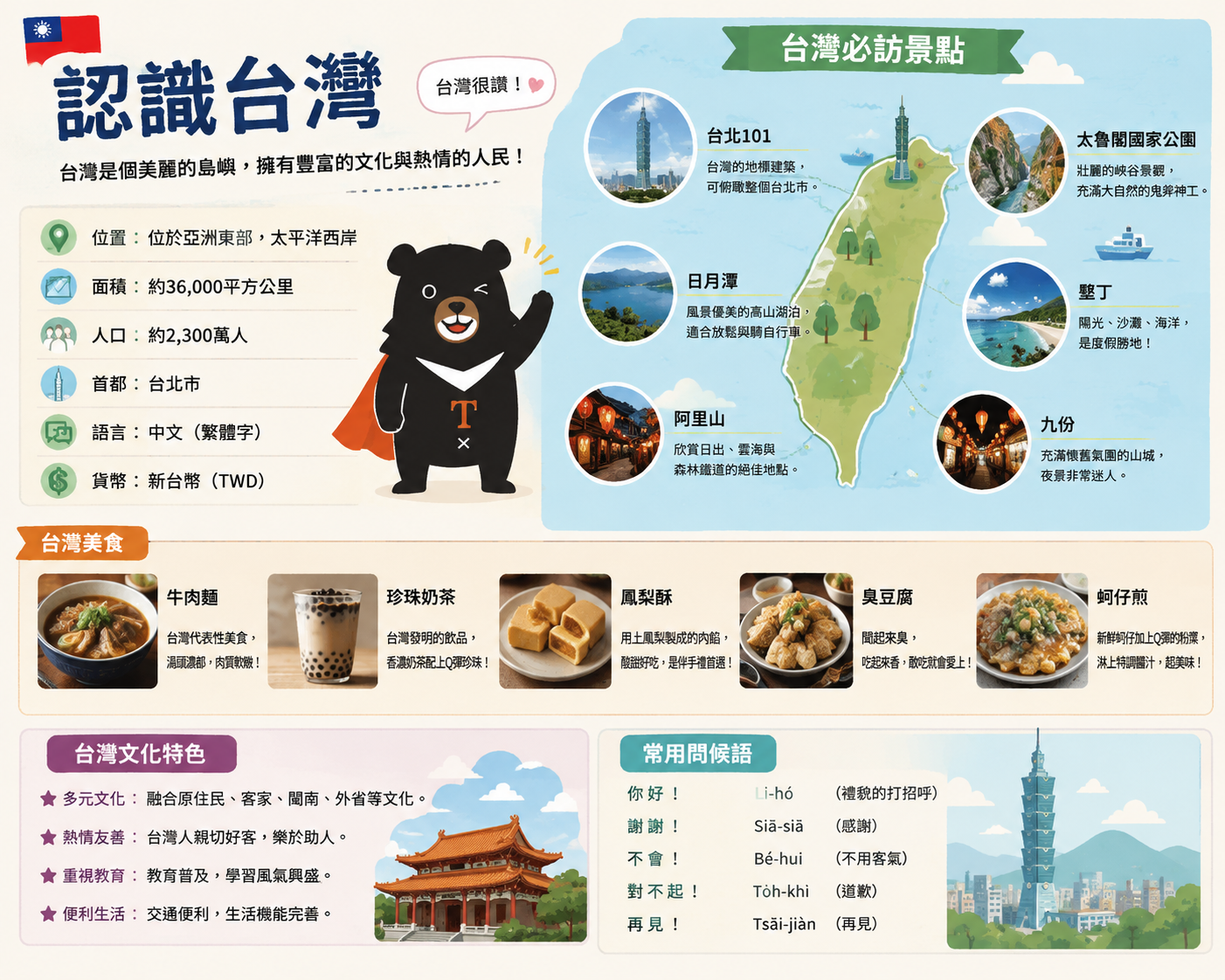
Language Taiwan Speak: What Languages Do People Use in Taiwan?
If you searched “language Taiwan speak,” the simplest answer is Mandarin Chinese. Mandarin is the language you are most likely to hear in schools, government offices, businesses, public transportation, television, and everyday conversations across Taiwan.
However, Taiwan is far more multilingual than this quick answer suggests. Taiwanese Hokkien, Hakka, Indigenous languages, Taiwan Sign Language, English, and several other languages are also part of the island’s linguistic landscape.
What Language Does Taiwan Speak?
Mandarin Chinese is the most widely used common language in Taiwan. It allows people from different regions and linguistic backgrounds to communicate with one another and is widely used in education, government, media, and professional settings.
Taiwan’s language laws also recognize linguistic diversity. Under the Development of National Languages Act, the natural languages and sign languages traditionally used by Taiwan’s different ethnic groups are considered national languages and are legally equal.
Taiwan Language Quick Facts
| Language | Where You May Hear It | General Use |
|---|---|---|
| Mandarin Chinese | Throughout Taiwan | Most widely used common language |
| Taiwanese Hokkien | Homes, markets, communities, media | Very common local language |
| Hakka | Hakka communities | Cultural and everyday community use |
| Indigenous languages | Indigenous communities | Cultural, family, and community communication |
| Taiwan Sign Language | Deaf community | Sign language communication |
| English | Tourism, business, education | Useful second/foreign language |
For a first-time visitor, Mandarin is the most practical language to know.
Is Mandarin the Main Language in Taiwan?
Yes. Mandarin is the dominant language for nationwide communication in Taiwan.
You will commonly encounter it when:
- ordering food
- shopping
- asking for directions
- taking trains or buses
- visiting government offices
- attending school or university
- watching television
- communicating in workplaces
Most people who grow up in Taiwan learn Mandarin, although the languages spoken within their families can be different.
What Kind of Mandarin Is Spoken in Taiwan?
The variety spoken locally is usually called Taiwan Mandarin.
Taiwan Mandarin and Mandarin spoken in mainland China are largely mutually understandable, but differences can appear in pronunciation, vocabulary, expressions, and writing conventions.
A person fluent in Mandarin should generally be able to communicate successfully in Taiwan.
Does Taiwan Use Traditional or Simplified Chinese?
Taiwan primarily uses Traditional Chinese characters.
This is one of the most important practical differences travelers and language learners should understand.
For example:
| English | Traditional Chinese | Simplified Chinese |
|---|---|---|
| Taiwan | 臺灣 / 台灣 | 台湾 |
| Language | 語言 | 语言 |
| Learn | 學習 | 学习 |
| Country | 國家 | 国家 |
Traditional characters appear on signs, menus, websites, books, government documents, advertisements, and educational materials throughout Taiwan.
Should Travelers Learn Traditional Chinese?
You do not need to read Chinese fluently before visiting Taiwan. However, recognizing a few Traditional Chinese characters can make transportation, restaurants, and shopping easier.
Translation apps can also help when you encounter menus or signs without English translations.
What Is Taiwanese Hokkien?
Another important answer to what language Taiwan people speak is Taiwanese Hokkien, often simply called Taiwanese and also known as Taigi.
It has a long history in Taiwan and remains an important part of local identity, entertainment, family life, traditional culture, and informal communication.
According to Taiwan’s Executive Yuan, Taiwanese is one of the island’s major local languages, alongside Hakka and Indigenous languages.
Is Taiwanese the Same as Mandarin?
No. Taiwanese Hokkien and Mandarin are different varieties of Chinese and are not simply different accents of the same language.
A Mandarin speaker who has never learned Taiwanese Hokkien will not automatically understand a conversation spoken entirely in Taiwanese.
This distinction is important because visitors sometimes assume that everyone speaking a Chinese language in Taiwan is speaking Mandarin.
Where Is Taiwanese Hokkien Commonly Spoken?
You may hear Taiwanese Hokkien in:
- traditional markets
- family gatherings
- temples
- local restaurants
- television programs
- political or community events
- conversations among older generations
- towns and neighborhoods where Taiwanese remains strongly used
Many people comfortably switch between Mandarin and Taiwanese depending on whom they are speaking with.
This language switching is a normal feature of everyday life in Taiwan.
Is Hakka Spoken in Taiwan?
Yes. Taiwan Hakka is another important part of Taiwan’s linguistic heritage.
Hakka contains several varieties spoken by Hakka communities around Taiwan. Taiwan’s Hakka Basic Act recognizes Hakka as one of Taiwan’s national languages and protects people’s rights to learn and use it.
Where Is Hakka More Common?
Hakka is particularly associated with communities in areas such as:
- Hsinchu
- Miaoli
- Taoyuan
- parts of Kaohsiung
- parts of Pingtung
Actual language use varies considerably between communities and generations.
Like several other local languages, Hakka is also the focus of language preservation and revitalization programs.
What Indigenous Languages Are Spoken in Taiwan?
Taiwan is home to numerous Indigenous peoples with their own languages.
These languages belong primarily to the Austronesian language family, connecting Taiwan linguistically to a much broader family of languages stretching across parts of Southeast Asia, the Pacific, and beyond.
Taiwan’s Indigenous Languages Development Act recognizes Indigenous languages as national languages and provides legal measures intended to support their preservation and development.
Why Are Taiwan’s Indigenous Languages Important?
They represent far more than alternative ways of speaking.
Languages preserve:
- oral history
- traditional knowledge
- cultural identities
- songs and stories
- relationships with the environment
- community traditions
- unique ways of expressing ideas
Several local languages face serious challenges in being passed from older generations to younger speakers, which is why language revitalization has become an important cultural issue in Taiwan.
Does Taiwan Have One Official Language?
This question requires more nuance than simply saying, “Mandarin is Taiwan’s official language.”
Mandarin functions as the main language of nationwide government, education, business, and public communication. However, Taiwan’s Development of National Languages Act defines the natural languages and sign languages used by its ethnic groups as national languages and states that national languages are equal.
Therefore, it is more accurate to describe Taiwan as a multilingual society where Mandarin is the dominant common language.
Is Taiwan Sign Language Recognized?
Yes. Taiwan Sign Language is included within Taiwan’s national-language framework.
Taiwan’s Development of National Languages Act defines national languages as natural languages and sign languages used by the country’s different ethnic groups.
This recognition reflects a broader approach to language rights that goes beyond spoken languages alone.
Do People Speak English in Taiwan?
English is commonly studied as a foreign language in Taiwan, and visitors may encounter English in major cities, airports, hotels, transportation systems, universities, tourist attractions, and international businesses.
However, you should not assume that everyone can comfortably hold a detailed conversation in English.
Where Is English Easier to Use?
English communication is generally easier in places such as:
- Taipei
- international hotels
- airports
- major railway stations
- universities
- tourist information centers
- international companies
- popular tourist attractions
Outside major urban and tourist environments, knowing a few Mandarin expressions or having a translation app can be extremely useful.
What Language Should Tourists Speak in Taiwan?
For tourists, Mandarin Chinese is the best language to learn.
You do not need months of language study. Even a handful of expressions can improve everyday interactions and demonstrate courtesy.
Useful Mandarin Phrases for Taiwan
| English | Traditional Chinese | Pinyin |
|---|---|---|
| Hello | 你好 | Nǐ hǎo |
| Thank you | 謝謝 | Xièxie |
| Excuse me / Sorry | 不好意思 | Bù hǎoyìsi |
| How much? | 多少錢? | Duōshao qián? |
| I don’t understand | 我聽不懂 | Wǒ tīng bù dǒng |
| Do you speak English? | 你會說英文嗎? | Nǐ huì shuō Yīngwén ma? |
Do not worry about perfect pronunciation. Polite effort combined with gestures, maps, and translation tools can solve many basic communication problems.
What Language Should You Learn Before Moving to Taiwan?
If you plan to study, work, or live in Taiwan for an extended period, start with Mandarin.
It provides the greatest practical return because it helps with housing, banking, transportation, shopping, employment, healthcare, friendships, and administrative tasks.
Learn Traditional Chinese Alongside Mandarin
If your goal goes beyond tourism, learn to recognize Traditional Chinese characters rather than relying entirely on Simplified Chinese.
Reading ability becomes particularly valuable when dealing with:
- rental agreements
- menus
- street signs
- government forms
- online shopping
- banking
- local apps
- workplace communication
Speaking Mandarin may get you through conversations, but reading Traditional Chinese can make everyday independence much easier.
Mandarin vs Taiwanese: What Is the Difference?
A simple comparison helps explain Taiwan’s linguistic environment.
| Feature | Mandarin | Taiwanese Hokkien |
|---|---|---|
| Nationwide use | Very high | Common but varies by community |
| Education | Main language of instruction | Taught and promoted in various contexts |
| Government communication | Widely used | Supported as a national language |
| Tourist usefulness | Very high | Helpful but not necessary |
| Mutual understanding | Different from Taiwanese | Different from Mandarin |
| Cultural importance | Major modern common language | Strong local and historical importance |
For visitors, Mandarin should normally come first. For people interested in local history, identity, community life, or Taiwanese culture, learning some Taiwanese can provide a deeper perspective.
Common Mistakes People Make About Languages in Taiwan
Calling Every Language “Chinese”
Taiwan’s linguistic landscape cannot be understood accurately by labeling every local language simply as Chinese.
Mandarin, Taiwanese Hokkien, Hakka, Indigenous languages, and Taiwan Sign Language have different histories and linguistic characteristics.
Assuming Taiwanese Is Just Mandarin With an Accent
Taiwanese Hokkien is not merely Mandarin pronounced differently.
They differ substantially enough that knowledge of one does not automatically provide conversational understanding of the other.
Expecting Everyone to Speak English
English signage can make Taiwan feel highly accessible to international visitors, particularly around transportation and tourism.
That does not mean English will work in every shop, neighborhood, taxi, restaurant, or personal conversation.
Learning Only Simplified Chinese Characters
Simplified Chinese knowledge can still be useful, especially because many characters remain recognizable.
However, Taiwan uses Traditional Chinese, so learners intending to live there benefit from becoming familiar with the local writing system.
Which Language Is Most Useful in Different Situations?
For Tourism
Learn basic Mandarin phrases and use English where available.
For University Study
Mandarin ability can improve daily life even when your academic program is taught in English.
For Working in Taiwan
The importance of Mandarin depends on your industry, employer, and position. International technology or multinational companies may use substantial English, while many local workplaces rely heavily on Mandarin.
For Exploring Local Culture
Mandarin gives you broad access, while Taiwanese, Hakka, or an Indigenous language can offer deeper connections to particular communities and traditions.
For Long-Term Living
Combining conversational Mandarin with basic Traditional Chinese reading skills is usually the most practical approach.
Why Does Taiwan Have So Many Languages?
Taiwan’s linguistic diversity reflects centuries of migration, Indigenous history, political change, education policies, community identities, and cultural exchange.
Rather than having a single linguistic identity, Taiwan contains overlapping language communities whose members may use different languages depending on their family, region, age, workplace, and social situation.
The government has increasingly emphasized preservation and revitalization of languages at risk of disappearing. Its national-language development programs seek to support linguistic diversity alongside the widespread use of Taiwan Mandarin.
Frequently Asked Questions
What is the main language spoken in Taiwan?
Mandarin Chinese is the most widely used common language in Taiwan. It dominates nationwide education, government communication, business, media, and many everyday situations.
Do Taiwanese people speak Chinese?
Yes. Most people speak Mandarin Chinese, while many also speak or understand Taiwanese Hokkien, Hakka, Indigenous languages, or other languages.
Is Taiwanese the same language as Chinese?
“Chinese” can refer to a broad group of related linguistic varieties. Taiwanese Hokkien is different from Mandarin and should not simply be treated as a Mandarin accent.
Can Mandarin speakers understand people in Taiwan?
Yes. Standard Mandarin speakers should generally be able to communicate in Taiwan, although vocabulary, pronunciation, expressions, and accents can differ.
Does Taiwan use Mandarin or Cantonese?
Mandarin is far more widely used. Cantonese may be spoken by some individuals and communities, but it is not Taiwan’s dominant everyday language.
Does Taiwan use Traditional Chinese?
Yes. Taiwan primarily uses Traditional Chinese characters in schools, publications, signs, websites, government documents, and daily written communication.
Can I travel around Taiwan using only English?
Many travelers manage with English, especially in major cities and tourist areas. Basic Mandarin phrases and a translation app are still useful when visiting smaller businesses, local neighborhoods, or less tourist-oriented areas.
Conclusion
For anyone searching “language Taiwan speak,” the most useful answer is that Mandarin Chinese is Taiwan’s dominant common language, but it is only one part of a much richer linguistic picture.
Taiwanese Hokkien, Hakka, Indigenous languages, and Taiwan Sign Language are important parts of Taiwan’s multilingual identity and are recognized within its national-language framework. Travelers should prioritize basic Mandarin and Traditional Chinese, while anyone interested in Taiwan’s culture will discover much more by exploring its diverse local languages.
