

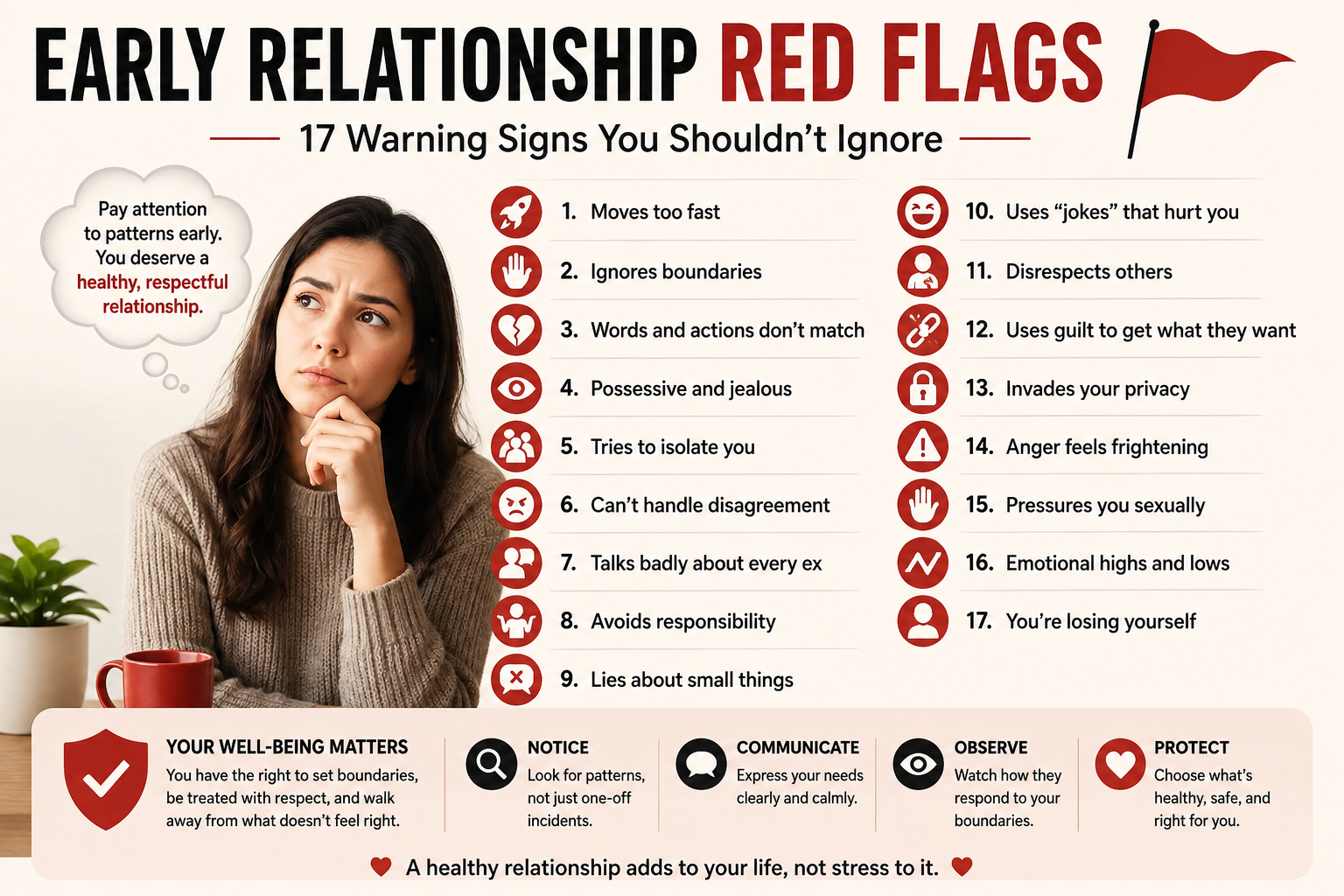
Early Relationship Red Flags: 17 Signs You Shouldn’t Ignore
New relationships can make almost everything feel exciting: the constant messages, long conversations, spontaneous plans, and rush of discovering someone new. That excitement can also make early relationship red flags surprisingly easy to rationalize.
A red flag is not simply an annoying habit or a personality difference. It is a behavior or pattern that may signal disrespect, manipulation, dishonesty, instability, controlling tendencies, or an inability to build a healthy relationship.
The key is not to scrutinize every imperfect moment. It is to notice patterns, pay attention to how the person responds when challenged, and decide whether the relationship gives you enough evidence to keep investing in it.
Quick Guide: Red Flag, Yellow Flag, or Simple Incompatibility?
Not every concern means you should immediately end a relationship. Knowing what kind of problem you are looking at can prevent both unnecessary panic and dangerous rationalization.
| What You Notice | What It Usually Means | Best Response |
|---|---|---|
| Red flag | Potentially harmful, manipulative, controlling, or deeply unhealthy behavior | Take seriously; establish distance or reconsider the relationship |
| Yellow flag | Something concerning that requires more information | Discuss it and watch whether the pattern continues |
| Incompatibility | Neither person is necessarily wrong, but your needs or values differ | Decide whether compromise is realistic |
| Normal imperfection | An isolated mistake followed by accountability and change | Communicate and observe what happens next |
One incident can matter, particularly when it involves intimidation, violence, coercion, stalking, or serious deception. For less severe concerns, patterns and responses to boundaries usually reveal more than a single awkward moment.
Why Early Relationship Red Flags Are Easy to Miss
The beginning of a relationship creates an unusual information problem: emotions often develop faster than evidence.
You may know how someone behaves while flirting, dating, and trying to impress you, but not yet know how they behave when they are disappointed, jealous, stressed, criticized, bored, or told no.
Attraction Can Make You Explain Away Contradictions
When you strongly want a relationship to work, your mind naturally searches for explanations that preserve the possibility.
“They’re just passionate.”
“They had a difficult ex.”
“They’re protective because they care.”
“They only said that because they were stressed.”
Any one of those explanations could be true. The mistake is repeatedly choosing the most flattering explanation while ignoring the person’s actual behavior.
Intensity Can Feel Like Compatibility
Rapid emotional intensity can create the impression that two people share an unusually deep connection.
But intimacy requires knowledge, trust, consistency, vulnerability, and time. Someone can generate tremendous emotional intensity before either of you knows enough about the other person to have genuine intimacy.
People Are Usually on Their Best Behavior Early On
Early dating often reveals someone’s presentation before it reveals their patterns.
That is why small moments involving boundaries, frustration, service workers, ex-partners, mistakes, disagreements, and delayed gratification can be unusually informative.
1. They Push the Relationship Forward Extremely Fast
There is nothing inherently wrong with two people becoming excited about each other quickly. The concern begins when enthusiasm turns into pressure.
Someone you barely know may start discussing marriage, moving in together, children, finances, or lifelong commitment while acting as though hesitation means you are not serious enough.
Watch particularly closely when they:
- Demand exclusivity almost immediately.
- Talk about you as their “soulmate” before knowing you well.
- Pressure you into major commitments.
- Become offended when you want to slow down.
- Treat caution as evidence that you do not care.
A healthy person may be enthusiastic and still respect your pace.
2. They Ignore Small Boundaries
One of the most revealing early relationship red flags is not necessarily a dramatic violation. It can be a series of small boundary tests.
You say you need to leave at 10, and they pressure you to stay. You say you are uncomfortable discussing something, and they keep asking. You decline a particular kind of physical contact, and they try again minutes later.
The issue is not merely whether the boundary seems important to them. The issue is whether your “no” matters without requiring a courtroom-quality explanation.
Watch What Happens After You Say No
A respectful partner may be disappointed by a boundary without punishing you for having one.
Be cautious if saying no routinely produces guilt trips, sulking, anger, ridicule, repeated negotiation, threats, or withdrawal of affection.
3. Their Words and Actions Regularly Conflict
Promises are cheap information. Patterns are expensive information.
Someone may say they value honesty while repeatedly hiding things. They may call themselves dependable while constantly canceling. They may promise to respect your boundaries and then search for loopholes.
Do not evaluate a relationship solely through stated intentions.
Ask yourself:
If I ignored everything this person said and judged only what they repeatedly did, what would I conclude?
That question can cut through a remarkable amount of confusion.
4. They Become Possessive and Call It Caring
Early jealousy is sometimes romanticized as proof that someone is highly interested.
Healthy interest does not require ownership.
Possessiveness may look like:
- Wanting constant updates about where you are.
- Becoming angry when you spend time with friends.
- Questioning innocent interactions with other people.
- Expecting immediate replies.
- Policing clothing, social media, or friendships.
- Treating ordinary independence as suspicious.
“I care about you” does not make controlling behavior healthy.
5. They Try to Isolate You From Other People
Isolation rarely begins with someone openly announcing that you can no longer see your friends or family.
It often starts with criticism.
“Your friends don’t really care about you.”
“Your sister is jealous of us.”
“Why do you need to go out when you could spend time with me?”
Over time, maintaining your existing relationships may become so exhausting that withdrawing feels easier.
A healthy relationship expands your life rather than requiring you to make it progressively smaller.
6. They Cannot Handle Disagreement
Compatibility is not demonstrated by never disagreeing. It is demonstrated by what happens when disagreement arrives.
Pay attention to whether the other person can hear an opinion they dislike without turning the conversation into a personal attack.
Warning signs include:
- Name-calling.
- Mocking your intelligence.
- Shouting to overpower you.
- Threatening to end the relationship during ordinary disagreements.
- Refusing to let you finish speaking.
- Punishing you with prolonged silence.
- Bringing up unrelated vulnerabilities to hurt you.
Conflict exposes relationship skills that chemistry can temporarily hide.
7. Every Ex Was Apparently “Crazy”
People can genuinely have painful former relationships. Having a difficult ex is not itself a red flag.
The concern is a pattern in which every previous partner is portrayed as completely unstable, malicious, jealous, obsessive, or responsible for every problem.
Listen for evidence of reflection.
A person capable of healthy relationships can usually identify at least something they learned, something they could have handled differently, or some nuance in what happened.
Someone who is always the innocent victim in every relationship may eventually tell the same kind of story about you.
8. They Never Take Responsibility
Everyone makes mistakes. Accountability determines what happens next.
Someone who struggles with responsibility may respond to concerns by denying obvious facts, minimizing the impact, attacking your character, blaming circumstances, or turning the conversation toward something you did wrong.
A healthy apology sounds closer to:
“I did that. It hurt you. I understand why. I should have handled it differently, and here’s what I’ll change.”
Accountability should eventually produce different behavior. Repeated apologies without behavioral change are simply another pattern.
9. They Lie About Small Things
People often overlook small lies because the subject itself appears unimportant.
But that can miss the larger issue.
If there was little reason to lie about where they were, who called them, whether they completed something, or what they previously said, the triviality of the subject does not necessarily make the dishonesty less relevant.
Instead of asking only, “Was this lie serious?” ask:
Why did dishonesty feel easier to this person than telling me the truth?
10. They Make Cruelty Look Like Humor
Teasing can be affectionate when both people genuinely enjoy it. It becomes a problem when humor consistently travels in one direction.
They criticize your appearance and call you sensitive. They embarrass you publicly and claim you cannot take a joke. They target known insecurities while protecting themselves behind sarcasm.
A useful test is simple: what happens when you tell them the joke hurt?
Someone who cares about you becomes interested in the impact. Someone who cares primarily about avoiding responsibility argues about whether you were allowed to be hurt.
11. They Disrespect People They Do Not Need to Impress
Notice how someone behaves toward people who offer them no romantic, professional, or social advantage.
Servers, drivers, cleaners, customer-support employees, junior colleagues, strangers, and family members can reveal a different side of someone’s character.
One impatient interaction proves little. A recurring pattern of contempt, entitlement, humiliation, or aggression deserves attention.
Charm directed upward and cruelty directed downward is not kindness.
12. They Use Guilt to Get What They Want
Manipulation does not always sound threatening.
It can sound wounded.
“If you loved me, you’d do this.”
“I guess I’m just more invested than you are.”
“Fine. I won’t ask you for anything ever again.”
These statements shift the conversation away from whether your boundary is reasonable and toward whether you are a good enough partner.
Healthy partners can communicate disappointment without making you responsible for regulating all of their emotions.
13. They Invade Your Privacy
Being in a relationship does not eliminate your right to privacy.
Demanding passwords, reading private messages, checking your phone without permission, tracking your location, accessing accounts, or insisting you prove your innocence are not automatically signs of closeness.
Trust is not demonstrated by surrendering all privacy.
If someone believes surveillance is the only way they can trust you, the underlying trust problem remains even after you hand them your phone.
14. Their Anger Feels Disproportionate or Frightening
Anger is a normal emotion. Intimidation is not a healthy conflict strategy.
Take seriously behavior such as punching walls, throwing objects, reckless driving during arguments, blocking doorways, destroying belongings, threatening people, invading your physical space, or implying that you should be afraid of what they might do.
You do not need to wait until aggression is directed physically at you before treating it as meaningful.
If you feel unsafe, prioritize your physical safety over getting the person to understand your perspective. Seek help from trusted people, relevant local support services, or emergency services when necessary.
15. They Pressure You Sexually
Consent is not a one-time hurdle someone clears at the beginning of an interaction.
It must remain voluntary.
Pressure can include repeatedly asking after you decline, becoming angry when you stop, framing sex as proof of love, using guilt, ignoring contraception agreements, or acting as though previous consent guarantees future consent.
A respectful partner wants your participation, not your reluctant compliance.
16. The Relationship Feels Like Constant Emotional Whiplash
Some relationships become intensely affectionate and intensely painful in rapid cycles.
One day you are idealized. The next day you are ignored, criticized, threatened with abandonment, or blamed for everything. Then the affection returns so strongly that the previous problem temporarily disappears.
Unpredictable rewards can make a relationship unusually difficult to evaluate because the good periods feel extraordinarily relieving.
Do not judge the relationship only by its emotional peaks. Evaluate the average experience.
17. You Are Becoming Less Like Yourself
Sometimes the clearest warning sign is not something the other person says. It is what you notice happening inside yourself.
Perhaps you are increasingly anxious about saying the wrong thing. You rehearse messages before sending them, hide harmless information to avoid conflict, stop seeing friends, abandon hobbies, or constantly monitor the other person’s mood.
Ask yourself:
- Am I more relaxed or more vigilant since this relationship began?
- Can I disagree without fearing retaliation?
- Can I maintain friendships and interests outside the relationship?
- Do I feel respected even when my partner is unhappy with me?
- Am I becoming more confident, or am I constantly second-guessing myself?
A healthy relationship does not require you to disappear in order to preserve it.
The Most Important Red Flag: How They React to Your Boundary
People naturally focus on the original problem, but the response to the problem is often more revealing.
Suppose your date repeatedly calls late at night even though you have an early work schedule. That behavior could result from enthusiasm, different communication habits, or simple thoughtlessness.
Then you say, “I like talking to you, but I can’t take calls after 10.”
Now you have better data.
A Healthy Response
They might say, “Got it. I didn’t realize it was disrupting your sleep.”
And then they stop calling late.
A Concerning Response
They may argue that you are distant, accuse you of not caring, continue calling anyway, or begin testing whether your boundary is negotiable.
The original issue was late-night calls. The more important issue became whether your needs deserved respect.
Red Flags vs. Normal Relationship Challenges
Healthy partners can be insecure, emotional, forgetful, awkward, stressed, or occasionally defensive.
The goal is not to find someone who never behaves imperfectly.
Instead, look at four variables:
Frequency
Is this an isolated mistake or something you repeatedly experience?
Severity
Was the behavior inconvenient, hurtful, dangerous, coercive, or frightening?
Accountability
Can the person recognize what happened without requiring you to prove that your feelings are legitimate?
Change
After discussing the problem, does behavior actually improve?
This framework is more useful than deciding whether one individual incident belongs on a universal internet checklist.
Early Green Flags That Matter Just as Much
Dating wisely is not only about identifying danger. You also need evidence that a relationship has healthy foundations.
Promising signs include:
- Their behavior is consistent over time.
- They respect “no” without punishment.
- They maintain friendships and support yours.
- They can apologize specifically.
- They are curious about your perspective.
- Their affection does not disappear whenever they are disappointed.
- They respect your time and commitments.
- They communicate directly instead of making you guess.
- They can disagree without becoming cruel.
- They show kindness when nobody important is watching.
- You can move at a pace that feels comfortable.
- You feel increasingly able to be yourself.
Green flags are strongest when they remain visible after the honeymoon phase begins to fade.
What to Do When You Notice a Red Flag
Not every concern requires the same response. Your next step should depend on the severity of the behavior and your level of safety.
1. Describe the Behavior Precisely
Avoid vague questions such as, “Is this relationship toxic?”
Instead identify what actually happened.
For example:
“He read my messages without permission twice after I told him not to.”
Specific observations are easier to evaluate than broad labels.
2. Separate Facts From Explanations
Write down what happened before deciding why it happened.
Fact: “She became angry when I went out with friends.”
Interpretation: “She behaves this way because she is afraid of losing me.”
The interpretation may be correct, but understanding a cause does not automatically make a behavior acceptable.
3. Communicate a Boundary When It Is Safe
For ordinary relationship problems, clearly explain what you need and what you will not accept.
Then pay close attention to the response.
You are not merely having a difficult conversation. You are learning whether the other person can participate in a relationship where your needs exist alongside theirs.
4. Watch Behavior Rather Than Promises
A dramatic apology can feel powerful, especially after conflict.
Give more weight to the following weeks than to the following twenty minutes.
Real change tends to become visible through consistent behavior.
5. Keep Your Support System
Continue seeing trusted friends and family members.
Outside perspectives can be particularly valuable when a relationship becomes emotionally intense because people who know you well may notice changes that are harder for you to recognize from inside the situation.
6. Leave When the Evidence Is Already Sufficient
You do not need unanimous approval, a psychological diagnosis, or proof beyond all doubt to end a dating relationship.
“This relationship does not feel healthy for me” is sufficient.
Dating exists partly to discover whether continuing the relationship makes sense.
Common Mistakes People Make When Evaluating Red Flags
Waiting for Absolute Proof
Relationships are not criminal trials.
If multiple concerning patterns repeatedly make you feel unsafe, controlled, demeaned, or emotionally exhausted, you do not have to remain until you can conclusively explain the person’s motives.
Confusing Potential With Current Reality
It is easy to date someone’s future version.
“They’ll become more responsible once work settles down.”
“They’ll stop being jealous once they trust me.”
“They could be an amazing partner if they dealt with their anger.”
Possibility matters less than the relationship you are actually experiencing.
Believing Understanding Something Means Accepting It
You may understand why someone fears abandonment, struggles with trust, or reacts defensively.
Compassion does not require unlimited tolerance.
A person’s history can explain behavior without making you responsible for enduring its consequences.
Focusing Only on Chemistry
Chemistry answers one question: are you strongly drawn to this person?
It does not tell you whether they are trustworthy, emotionally mature, compatible, respectful, or safe.
Those questions require separate evidence.
Ignoring Your Own Behavior
Relationship evaluation should also involve self-reflection.
Are you communicating honestly? Respecting boundaries? Taking responsibility? Managing jealousy appropriately? Allowing the other person independence?
Healthy standards should work in both directions.
When Is a Red Flag Serious Enough to Walk Away?
There is no universal formula, but some behaviors justify a much lower threshold for leaving.
Treat violence, threats, sexual coercion, stalking, intimidation, severe controlling behavior, deliberate isolation, repeated serious deception, and persistent boundary violations as especially significant.
For less severe problems, consider the pattern.
A useful question is:
If nothing about this behavior changed for the next three years, would I willingly choose this relationship?
If the answer is clearly no, do not build your decision around the hope that someone will eventually become different.
Can Early Relationship Red Flags Be Fixed?
Some relationship problems can improve. People can learn better communication, recognize unhealthy habits, seek professional support, and make meaningful changes.
But change requires more than regret.
Look for three things: acknowledgment without excuses, concrete action, and sustained improvement over time.
You cannot create another person’s accountability for them.
How Long Should You Watch Before Deciding?
There is no mandatory waiting period.
Dangerous, coercive, or abusive behavior does not deserve an extended observation window. You can act immediately when safety is involved.
For lower-level concerns, enough time to observe the person’s response to communication and boundaries may provide useful information.
The important question is not, “Have I given this enough months?”
It is, “What additional evidence am I realistically waiting for?”
Frequently Asked Questions About Early Relationship Red Flags
What are the biggest red flags at the beginning of a relationship?
Some of the most significant include controlling behavior, repeated dishonesty, boundary violations, extreme jealousy, intimidation, sexual pressure, isolation from friends or family, lack of accountability, and rapidly escalating commitment combined with pressure.
Patterns matter, but severe behavior can be meaningful even when it happens once.
Is moving fast always a red flag?
No.
Two people can genuinely feel excited and choose to move quickly. The red flag is usually pressure: one person pushes for commitment, dismisses hesitation, or makes the other person feel guilty for wanting more time.
Is jealousy an early relationship red flag?
Occasional jealousy is a common human emotion. What matters is how someone manages it.
Jealousy becomes more concerning when it produces accusations, surveillance, possessiveness, restrictions, repeated interrogations, or attempts to control who you see.
Can someone have red flags and still be a good person?
Yes.
A red flag evaluates behavior and relationship risk, not someone’s entire moral worth. A person can have admirable qualities and still be unable to offer you a healthy relationship.
Should I tell someone why I’m ending things?
You can explain your decision when doing so feels appropriate and safe, but you are not obligated to debate someone into agreeing with your breakup.
If you expect intimidation, manipulation, aggression, or retaliation, prioritize safety rather than closure.
What if my friends notice red flags that I don’t see?
Listen carefully without automatically accepting or dismissing their conclusions.
Ask them for specific examples rather than general statements. People outside an intense new relationship sometimes notice changes or inconsistencies more easily because they are less emotionally invested.
A Better Rule Than “Trust Your Gut”
Your instincts matter, particularly when something feels unsafe. But intuition becomes even more useful when paired with observable evidence.
Instead of relying exclusively on “something feels wrong,” ask:
- What specific behavior am I reacting to?
- Has it happened more than once?
- Have I changed my behavior to avoid their reaction?
- What happened when I expressed discomfort?
- Does their explanation match their actions?
- Would I advise a friend to accept the same treatment?
- Am I staying because the relationship is healthy or because I hope it will become healthy?
Your feelings are information. Patterns help you interpret that information.
Final Thoughts
Recognizing early relationship red flags does not require becoming suspicious of every person you date. It requires staying curious long enough to see the difference between attraction and trust, promises and patterns, ordinary flaws and unhealthy behavior.
Watch how someone handles boundaries, disappointment, accountability, independence, and conflict. Those moments often reveal far more about the future of a relationship than romantic intensity ever will.
The right relationship should not require constant detective work. Over time, healthy behavior tends to create greater clarity, safety, trust, and freedom to be yourself—not greater confusion about whether your needs are reasonable.
