

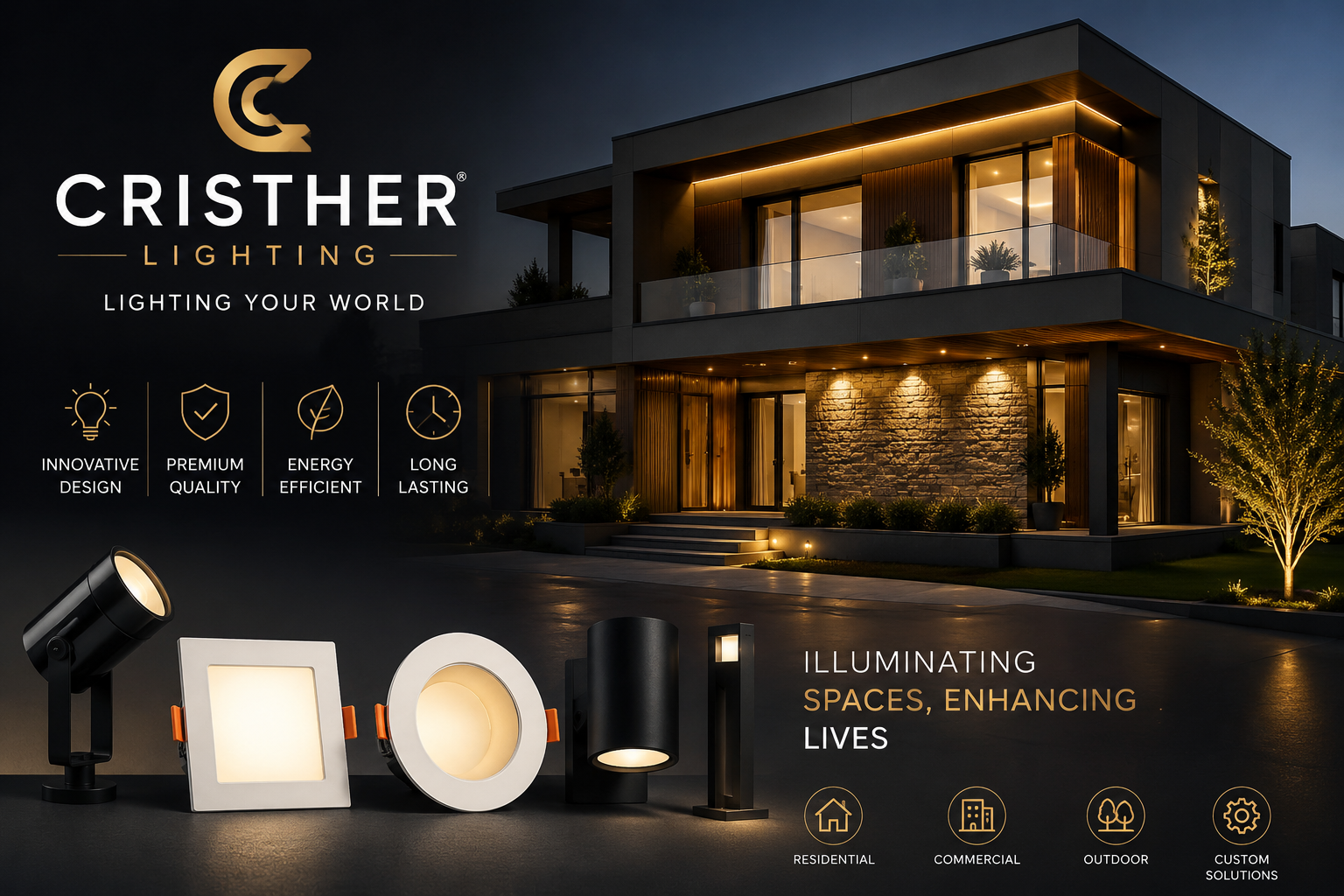
Cristher Lighting is designed for people who need more than basic exterior illumination. Its range combines architectural styling, professional optics, weather-resistant construction, and flexible technical configurations for residential, hospitality, landscape, and commercial projects.
However, choosing the right outdoor fixture requires more than selecting an attractive design. You must consider the installation location, beam distribution, brightness, color temperature, ingress protection, glare control, material, maintenance access, and compatibility with the wider lighting scheme.
This guide explains the Cristher product range, its main applications, important technical specifications, standout collections, advantages, limitations, and the practical steps required to plan an effective outdoor lighting project.
Quick Facts
- Primary focus: Residential and architectural outdoor lighting
- Parent company: Novolux Lighting
- Main product types: Wall lights, bollards, recessed fittings, spotlights, underwater lights, decorative fixtures, pendants, and accessories
- Typical applications: Gardens, façades, terraces, walkways, entrances, hospitality spaces, pools, and public areas
- Design approach: Contemporary aesthetics combined with professional lighting technology
- Current resource: Novolux Lighting lists a General Catalogue 2026 on the official Cristher brand page.
What Is Cristher Lighting?
Cristher is the high-end outdoor lighting brand within the Novolux Lighting portfolio. The manufacturer positions it as a meeting point between architectural design and the technical requirements of professional exterior lighting projects.
The range is intended for projects where the fixture must contribute visually during the day while producing controlled, purposeful illumination after dark. Products are available with different optics, luminous outputs, color temperatures, dimming options, materials, finishes, and installation methods.
Novolux Lighting states that it has more than 40 years of experience in indoor and outdoor lighting. Its company profile describes Cristher as a residential and architectural exterior range distinguished by product variety, modularity, customizable solutions, technical quality, and refined finishes.
Who Should Consider Cristher Lighting?
Cristher Lighting is especially relevant to:
- Architects specifying exterior luminaires for premium residential developments
- Landscape designers illuminating paths, trees, walls, sculptures, and planting
- Interior designers extending a visual concept into terraces and courtyards
- Hospitality professionals designing hotels, restaurants, resorts, and outdoor dining areas
- Electrical consultants who need documented technical options
- Homeowners seeking coordinated architectural lighting rather than isolated decorative lamps
- Contractors working on façades, communal gardens, pools, entrances, and pedestrian areas
For a small utility area requiring one inexpensive security light, the range may offer more design and specification options than necessary. Its strongest value appears in projects where appearance, visual comfort, durability, and lighting control must be considered together.
Cristher Lighting Product Categories
The Cristher catalogue covers multiple layers of outdoor lighting rather than concentrating on one fixture type. Its official categories include bollards and columns, surface-mounted fittings, recessed luminaires, spotlights, underwater lights, pendants, decorative products, floor and table lamps, and accessories.
| Product category | Best suited to | Primary lighting role | Important specification |
|---|---|---|---|
| Bollards and columns | Paths, gardens, entrances and open areas | Guidance and low-level ambient light | Height, beam direction and glare control |
| Surface-mounted lights | Exterior walls, ceilings and façades | General, accent or entrance lighting | Light distribution and mounting position |
| Recessed luminaires | Steps, walls, floors and pathways | Discreet orientation or architectural effects | Recess depth, drainage and load requirements |
| Spotlights | Trees, façades, sculptures and landscape features | Focused accent lighting | Beam angle, aiming range and glare shields |
| Underwater lights | Pools, fountains, spas and water features | Submerged decorative or functional light | Suitable IP rating and installation system |
| Pendant lights | Covered terraces, pergolas and outdoor dining areas | Decorative ambient or task lighting | Ceiling suitability and weather exposure |
| Decorative fixtures | Patios, hospitality spaces and garden rooms | Atmosphere and visual identity | Scale, diffusion and finish |
| Floor and table lamps | Flexible seating and lounge areas | Portable decorative light | Power supply, stability and outdoor rating |
| Accessories | Controls, drivers, mounting and installation | System completion | Product compatibility |
Bollards and Columns
Bollards illuminate pedestrian routes without relying on tall poles or overhead fittings. They can define a path, identify a level change, reinforce a landscape rhythm, or provide low-level illumination around a terrace.
The official Cristher bollard range includes families such as Dain, Dion, Duomo, Turret, Cok, Aura, Arya, Fram, Mini Nico, Mirco, and Matera. Available models vary in height, light source, emission pattern, finish, output, and form.
A good bollard should place light on the walking surface while limiting direct brightness toward a person’s eyes. More output is not always better; careful optical control usually produces a more comfortable result.
Surface-Mounted Wall and Ceiling Lights
Surface-mounted products are among the most versatile exterior fixtures. They can illuminate doors, balconies, covered walkways, façades, columns, patios, and perimeter walls.
The Cristher surface category contains numerous LED and non-integrated-light-source options, including fixtures designed for downward, upward, or combined up-and-down emission.
For example, the Milan family is made from aluminium, carries an IP65 rating, and is available with either downward or combined upward-and-downward emission for residential and commercial exterior areas.
Recessed Lighting
Recessed luminaires provide illumination with minimal visual interruption during the day. They may be fitted into walls, steps, floors, decks, pathways, or architectural surfaces.
Cristher represents a substantial portion of Novolux’s exterior recessed range, with families covering wall-recessed and ground-recessed applications.
These products require early coordination. The recess dimensions, housing, cabling, drainage, mounting sleeve, floor construction, and future service access should be confirmed before concrete, paving, plaster, or cladding work is completed.
Outdoor Spotlights
Spotlights are used when the objective is to reveal a specific feature rather than illuminate an entire space evenly. Typical targets include mature trees, textured walls, signs, sculptures, columns, planting, and façade details.
Cristher spotlight families include Disc, Kalos, Lance, Stone, Walk, Tina, Gibson, Fuji, Dado, and others. The range includes variations in power, material, optics, light source, and installation method.
The Kalos L projector, for example, uses an LED COB source, carries an IP65 rating, and is offered with a controlled optical distribution rather than an unrestricted wash of light.
Underwater Lighting
Underwater luminaires are intended for swimming pools, spas, fountains, and water features. The wider Novolux underwater category includes wall- and floor-installed fittings manufactured from materials such as stainless steel, brass, and thermoplastic.
Cristher accessories and related products include options with IP67 and IP68 protection classifications. The exact rating, permitted installation depth, power supply, cable arrangement, and pool compatibility must be confirmed from the specific product datasheet.
Never assume that an ordinary exterior spotlight can be submerged simply because it is weather resistant.
How to Choose the Right Cristher Lighting
1. Define the Purpose Before Selecting the Fixture
Begin with the task the light must perform:
- Guide people along a walkway
- Reveal steps or level changes
- Illuminate an entrance
- Highlight a tree or façade
- Add atmosphere to outdoor dining
- Improve visibility around a pool
- Create a decorative nighttime identity
- Support cameras or security monitoring
One fixture should not automatically be expected to perform every role. A bright wall light may illuminate an entrance but create uncomfortable glare across a seating area. A narrow spotlight may reveal a tree beautifully but leave the nearby path unusable.
2. Build the Design in Layers
Successful outdoor schemes normally combine several layers:
- Orientation lighting for paths, steps and entrances
- Ambient lighting for terraces and occupied spaces
- Accent lighting for architecture, planting and focal points
- Task lighting for cooking, serving or working
- Decorative lighting for character and atmosphere
Cristher’s mix of bollards, recessed fittings, surface lights, projectors, decorative fixtures, and portable lamps makes this layered approach possible within one broad product family.
3. Check the IP and IK Ratings
An IP rating describes the degree of protection provided by an enclosure against solids and water. The correct rating depends on whether the luminaire will be installed under a roof, on an exposed wall, close to irrigation, in the ground, or underwater.
Impact resistance may also matter in public paths, driveways, schools, commercial developments, and areas exposed to equipment or vandalism. Cristher products vary by model: the Disc spotlight, for example, is listed with IP65 and IK06 protection, while other product groups include different protection levels.
Do not select an IP rating based only on the general word “outdoor.” Evaluate the exact exposure conditions and follow the individual datasheet.
4. Select Color Temperature Intentionally
Correlated color temperature, or CCT, describes the visual appearance of white light and is measured in kelvin. It should be considered alongside the surrounding materials, landscape, architectural style, and intended atmosphere.
A practical starting point is:
- 2700K: Warm, intimate and suited to hospitality, traditional architecture and relaxed residential spaces
- 3000K: Warm but crisp enough for many contemporary residential and landscape projects
- 4000K: More neutral and often chosen where visual clarity or a cooler architectural appearance is required
Cristher families may be available in more than one CCT. Turret is offered in 3000K and 4000K, while Disc includes 2700K, 3000K, and 4000K versions.
Avoid mixing several color temperatures across one visible elevation unless the contrast is an intentional design decision.
5. Evaluate the Beam Angle
Beam angle determines how concentrated or broad the light appears.
- A narrow beam can emphasize columns, tall trees, sculptures, and detailed façade elements.
- A medium beam works well for planting groups, wall textures, and architectural features.
- A wide beam provides broader coverage for general illumination.
The Disc family demonstrates the value of optical choice, with listed lens options of 14°, 34°, and 49°. It can also be mounted on a wall, ceiling, or floor with a spike, allowing the same visual language to serve different applications.
Choose the beam according to the target’s size and distance. A narrow beam aimed at a short wall can create an aggressive hotspot, while a wide beam may waste light around a tall, narrow feature.
6. Compare Lumens, Not Wattage Alone
Wattage indicates electrical power consumption, not the complete lighting result. Luminous output, optical efficiency, beam shape, mounting height, surface reflectance, and aiming all affect how bright the installation appears.
Two fixtures with similar wattage can create very different results if one uses a narrow controlled beam and the other distributes light across a wide area.
Request the product’s:
- Delivered lumens
- Beam angle
- Photometric file
- Light distribution diagram
- Wattage
- CCT
- CRI
- Dimming protocol
- Driver information
For significant projects, use photometric calculations rather than judging performance from catalogue photographs.
7. Consider Dimming and Controls
The official Cristher positioning highlights flexibility in timing, dimming, optics, color temperature, special LEDs, and luminous flux.
Controls can improve both experience and efficiency. Useful options include:
- Astronomical timers
- Dusk-to-dawn sensors
- Motion detection
- Scene controls
- DALI systems
- Phase dimming, where supported
- Separate circuits for functional and decorative layers
The U.S. Department of Energy recommends directing light only where needed, using the minimum necessary amount, selecting color carefully, and applying controls so outdoor lighting operates only when required.
Notable Cristher Lighting Families
Product availability and specifications can change, so these families should be treated as useful examples rather than a substitute for the latest catalogue or datasheet.
Turret
Turret is a minimalist bollard produced in two listed heights: 500 mm and 750 mm. It is manufactured from extruded aluminium, finished in anthracite, rated IP65, and offered in 3000K and 4000K.
Its restrained form suits contemporary paths, gardens, residential entrances, and projects where the bollard should visually integrate with the architecture.
Disc
Disc is a flexible projector family with wall, ceiling, floor, and spike-mounted possibilities. It offers adjustable aiming, multiple beam angles, two listed wattages, white or anthracite finishes, and three color temperatures.
This range is particularly useful when a project needs several accent-lighting applications without introducing unrelated fixture designs.
Dion
Dion is a design-led outdoor family created by Jordi Blasi. Novolux states that it received a Bronze Delta at the ADI 2020 Awards.
The collection includes different bollard sizes and is relevant to projects seeking a recognizable architectural object as well as functional illumination.
Dain
Dain includes bollard and wall-recessed solutions, making it possible to repeat a coordinated design language across paths, low walls, steps, and transition areas.
This type of family-based specification usually creates a more coherent result than selecting every luminaire independently.
Terra
Terra is an adjustable outdoor spotlight with a ground spike. It is manufactured from aluminium with a transparent polycarbonate diffuser, carries an IP65 rating, and is listed in 3000K and 4000K.
Its spike-mounted construction suits landscape features where the position or aiming may need to be adjusted during commissioning.
Duomo
Duomo is available in wall-light and bollard versions, allowing the same visual character to be used vertically on architecture and at lower levels within the landscape.
Cristher Lighting Advantages and Limitations
| Advantages | Possible limitations |
| Broad selection of architectural outdoor fixtures | The large catalogue can make selection complicated |
| Coordinated families across multiple mounting types | Professional guidance may be needed for optics and controls |
| Multiple CCT, beam, output and dimming possibilities | Not every configuration is available for every product |
| Products for walls, paths, landscapes, pools and terraces | Recessed and underwater fittings require careful coordination |
| Contemporary, project-oriented styling | Premium specifications may exceed the needs of basic installations |
| Options for residential, hospitality and architectural projects | Prices and availability may vary by distributor and region |
| Technical product data available for specification | Integrated LED models may require complete luminaire replacement at end of life |
A Practical Outdoor Lighting Design Process
Step 1: Survey the Site
Record:
- Dimensions and mounting heights
- Walking routes
- Steps and hazards
- Trees and planting
- Building materials
- Seating positions
- Water features
- Existing electrical points
- Nearby windows and neighboring properties
- Areas requiring security visibility
A daytime survey alone is not enough. Observe the site after dark to understand existing ambient light, reflections, shadows, and neighboring sources.
Step 2: Mark Lighting Priorities
Divide the project into three levels:
- Essential: Paths, stairs, entrances and hazards
- Important: Terraces, architectural surfaces and key planting
- Optional: Sculptures, secondary trees and decorative effects
This prevents the budget from being consumed by decorative fixtures before essential lighting is resolved.
Step 3: Choose Fixture Families
Use a limited number of compatible families to create consistency. For example:
- One wall-light family for façades and entrances
- One bollard family for routes
- One recessed family for steps
- One adjustable projector family for landscape accents
Repeating forms, finishes and color temperatures makes the project feel deliberate.
Step 4: Produce a Lighting Layout
The layout should identify:
- Fixture reference
- Quantity
- Mounting position
- Mounting height
- Aiming direction
- Circuit
- Control method
- CCT
- Beam angle
- Driver location
- Required accessories
For architectural, hospitality, and public projects, request photometric calculations to evaluate illuminance, uniformity, glare, spill light, and energy use.
Step 5: Create a Nighttime Mock-Up
A mock-up can expose problems that drawings miss:
- A spotlight may reveal glare from a seating position.
- A bollard may produce excessive brightness at eye level.
- A wall washer may exaggerate surface defects.
- A recessed fitting may create an uneven pattern.
- A tree canopy may block more light than expected.
Test at least one example of each critical fixture type before approving a large order.
Step 6: Commission the Installation
Commissioning should include:
- Final aiming
- Dimming adjustment
- Timer programming
- Sensor testing
- Scene setup
- Verification of CCT consistency
- Checking light spill into windows
- Confirming safe route visibility
Many exterior installations look harsh simply because every fixture is left at maximum output.
Common Mistakes to Avoid
Choosing by Appearance Alone
A fixture can look excellent in daylight but perform poorly if its beam, output, glare, or mounting height does not suit the site.
Review the photometric information alongside the product image.
Overlighting the Space
More light can reduce comfort instead of improving it. Excessive brightness creates glare, flattens visual contrast, wastes energy, and may spill into neighboring properties or the night sky.
IES guidance identifies glare, sky glow, light trespass, and environmental impact as central concerns in responsible exterior lighting.
Using One Fixture Type Everywhere
A row of identical bright wall lights cannot effectively replace path lights, step lights, landscape projectors, and decorative terrace lighting.
Layer the design according to the task.
Ignoring Drainage Around Recessed Fixtures
Ground-recessed luminaires need suitable housings, drainage, waterproof connections, and installation details. Poor groundwork can cause water accumulation even when the luminaire itself has a suitable IP rating.
Selecting the Wrong Beam
A wide beam used for a narrow column wastes light. A narrow beam used for a broad tree canopy creates a small hotspot and leaves most of the feature dark.
Match the beam to the target’s width, height, and distance.
Mixing Finishes Without a Plan
Using unrelated black, white, anthracite, stainless-steel, and brown fixtures across one small space can make the installation appear fragmented.
Coordinate finishes with doors, windows, railings, furniture, stone, and façade materials.
Forgetting Maintenance Access
Drivers, junctions, recessed housings, underwater fittings, and high-mounted luminaires must remain serviceable.
A visually clean installation should not require breaking finished surfaces whenever a component needs inspection.
Installation and Maintenance
Outdoor luminaires should be installed by qualified personnel in accordance with the manufacturer’s instructions and applicable electrical requirements. A Novolux installation document for an outdoor Cristher fitting specifically states that installation should be carried out by qualified personnel and that suitability depends on the indicated IP classification.
Before installation, verify:
- Supply voltage
- Driver requirements
- Dimming compatibility
- Earthing arrangement
- Cable type
- Junction-box protection
- Mounting surface
- Drainage requirements
- Product orientation
- Required accessories
For maintenance:
- Disconnect power before inspection.
- Clean diffusers using methods approved in the product instructions.
- Remove leaves, soil, mineral deposits, and debris.
- Check seals, glands, screws, and mounting points.
- Re-aim adjustable projectors when planting grows.
- Test timers, sensors, and dimming scenes seasonally.
- Inspect ground fittings after flooding, landscaping, or paving work.
Questions to Ask Before Ordering
Request clear answers to the following:
- What is the exact product reference?
- Is the LED integrated or replaceable?
- Is the driver included?
- Where will the driver be installed?
- What is the delivered lumen output?
- Which CCT and CRI are supplied?
- What beam angle is included?
- Is another optic available?
- What are the IP and IK ratings?
- Is the fitting suitable for the exact mounting position?
- What dimming protocol is supported?
- Are mounting sleeves, spikes, connectors, or housings included?
- What are the cut-out and recess dimensions?
- Is a photometric file available?
- What warranty applies in the purchase region?
- Are replacement drivers or other components available?
- What is the estimated lead time?
- Are samples available for a nighttime mock-up?
Frequently Asked Questions
Is Cristher Lighting an indoor or outdoor brand?
Cristher primarily focuses on premium residential and architectural outdoor lighting. Its official categories cover surface, recessed, bollard, spotlight, underwater, pendant, decorative, portable, and accessory solutions.
Who owns Cristher Lighting?
Cristher is part of Novolux Lighting, alongside brands serving other decorative, functional, technical, and linear-lighting categories.
Does Cristher offer LED lighting?
Yes. Many Cristher products use integrated LED SMD or LED COB technology, while some families accept replaceable lamps. The light-source arrangement must be checked for each product reference.
Is Cristher suitable for gardens?
Yes. Its bollards, spike-mounted projectors, wall lights, recessed fittings, and decorative fixtures can be combined for garden paths, planting, trees, terraces, walls, and entrances.
Does Cristher manufacture pool lighting?
The catalogue includes underwater lighting and related accessories for pools, spas, fountains, and other water applications. Always confirm the exact IP rating, installation depth, electrical arrangement, and product instructions.
Which Cristher color temperature should I choose?
For relaxed residential and hospitality settings, 2700K or 3000K often creates a warmer visual effect. A 4000K option may be suitable where a more neutral appearance or stronger visual clarity is required.
The final decision should consider architecture, materials, landscape, surrounding lighting, project regulations, and the atmosphere you want to create.
Is IP65 enough for every outdoor installation?
No. IP65 may be appropriate for many exposed wall, bollard, or landscape applications, but it does not automatically make a product suitable for immersion, every ground-recessed condition, or every high-pressure water exposure.
Select protection according to the actual environment and the manufacturer’s instructions.
Are Cristher fixtures dimmable?
Some Cristher products offer dimming or control options, but compatibility varies. Confirm the fixture, driver, control protocol, minimum load, and wiring arrangement before purchase.
Final Verdict
Cristher Lighting is best suited to projects where outdoor fixtures must provide both architectural value and controlled lighting performance. Its broad catalogue allows designers to coordinate walls, paths, landscapes, façades, terraces, water features, and decorative spaces through related product families.
The key is not to choose solely by appearance. Define the lighting task, confirm the IP and IK requirements, compare delivered lumens and optics, coordinate color temperature, plan controls, review installation details, and test critical fixtures after dark.
Used as part of a carefully layered design, Cristher Lighting can create outdoor spaces that remain safe, visually comfortable, atmospheric, and architecturally coherent long after sunset.
