

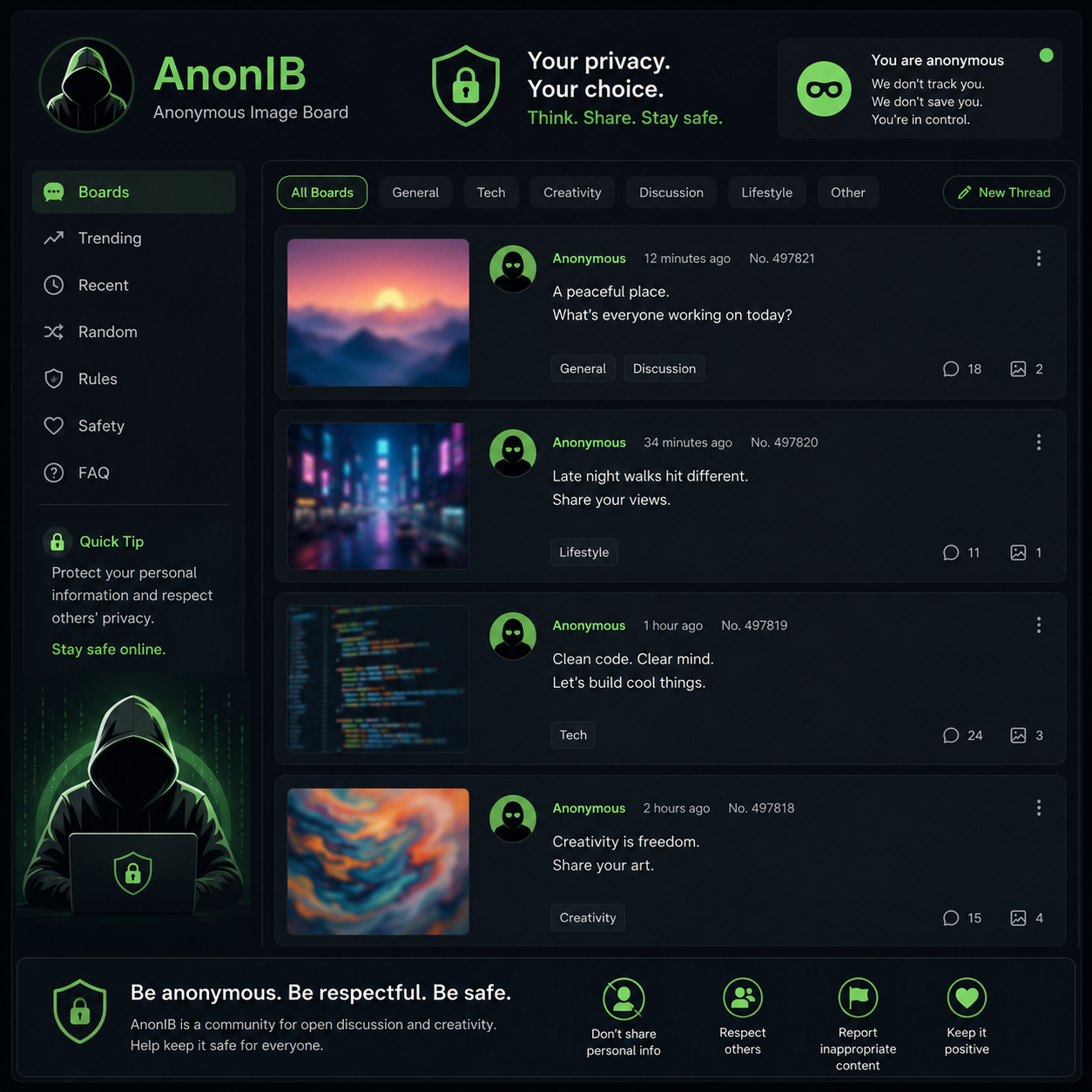
Searches for new anonib usually come from people trying to understand whether AnonIB has returned, whether a newer version exists, and what these anonymous image-board communities actually involve.
The important point is that “New AnonIB” is not a clearly verified official successor to the original Anon-IB. The historic platform was taken offline by Dutch authorities in 2018 during an investigation involving the non-consensual distribution of intimate images. Later websites have attempted to reuse its name, appearance, or community model.
That history makes the topic very different from an ordinary social-network or forum guide. Anyone researching New AnonIB should understand not only how anonymous image boards work but also their privacy, consent, security, moderation, and legal implications.
New AnonIB Quick Facts
| Topic | What You Should Know |
|---|---|
| Meaning | Usually refers to newer sites or communities using the AnonIB name or format |
| Platform type | Anonymous or pseudonymous image-board community |
| Original Anon-IB | Taken offline in 2018 |
| Official successor | No clearly verified official successor has been established |
| Main attraction | Anonymous posting and image-centered discussions |
| Major concern | Privacy, consent, harassment, doxxing, and image-based abuse |
| Account required | Depends on the particular platform or clone |
| Safe to assume anonymity? | No |
| Best approach | Treat unknown AnonIB-style sites cautiously |
What Is New AnonIB?
The phrase new anonib does not necessarily describe one single website. In practice, it is often used as a search term for websites, mirrors, replacements, or communities attempting to reproduce the anonymous image-board experience historically associated with Anon-IB.
Image boards differ from conventional social networks because discussions are generally organized around threads containing images and short replies rather than permanent personal profiles.
Anonymous posting can reduce the amount of identity information displayed publicly, but it does not automatically make a user technically anonymous. Australia’s eSafety Commissioner notes that identity shielding can protect legitimate privacy while also making accountability more difficult when anonymous systems are abused.
This distinction matters.
Anonymous posting is not the same thing as guaranteed privacy.
A website may hide your name from other users while still processing technical information such as network data, browser information, cookies, timestamps, or uploaded-file metadata.
Why Are People Searching for New AnonIB?
There are several different types of search intent behind the keyword.
Some users remember the historic Anon-IB and want to know whether it has returned. Others encounter the name on forums or social media and simply want an explanation.
Another group may be trying to understand an unfamiliar AnonIB-branded domain before visiting it. This is particularly important because third-party web analytics services were still identifying multiple AnonIB-named or similarly branded websites in 2026, but the existence of such domains does not establish that they are operated by the people behind the historical platform.
There is also a more serious category of searches from people who believe their photographs, personal details, or intimate material have appeared on an anonymous image board without permission.
For that reason, a useful New AnonIB guide should focus on verification and safety rather than simply directing readers toward whichever domain currently uses the name.
The History Behind the AnonIB Name
Understanding new anonib requires some historical context.
Anon-IB became known as an anonymous image-sharing forum, but its reputation became closely connected with the distribution of intimate photographs without the consent of the people depicted.
In April 2018, Dutch authorities took Anon-IB offline during an investigation. Contemporary reporting described sections where unlawfully obtained or non-consensually distributed photographs had been exchanged.
That shutdown did not eliminate demand for anonymous image-board communities.
In 2020, reporting documented attempts to revive websites using the Anon-IB name and visual identity. Those attempted successors raised many of the same concerns surrounding consent and non-consensual intimate imagery.
This is why the label “New AnonIB” should not automatically be interpreted as an official relaunch.
How Anonymous Image Boards Work
Anonymous image boards generally use a thread-based structure.
A visitor creates a discussion by uploading an image, writing a message, or combining the two. Other visitors reply beneath that original post, and newer activity may move a thread higher on the board.
Traditional image-board culture often minimizes persistent identities. Some platforms permit usernames or pseudonymous identifiers, while others encourage users to post without recognizable profiles.
Posts Instead of Personal Profiles
Mainstream social media is usually identity-centered.
You follow people, build profiles, accumulate followers, and maintain a visible posting history.
Image boards tend to be content-centered instead. The thread matters more than the individual account.
That structure can support open discussion, but reduced accountability can also make harassment and abusive sharing harder to control.
Boards and Categories
Image-board platforms frequently divide discussions into themed areas.
Depending on the service, categories might cover general conversation, hobbies, entertainment, locations, photography, or adult material.
The presence of a category does not mean every upload within it is lawful or consensual. Platforms dependent on user-generated content can receive material that violates their own policies or applicable laws.
Temporary Content Can Still Become Permanent
Some anonymous communities give the impression that posts are temporary because threads eventually disappear from the main board.
Users should not interpret disappearance as deletion.
Someone can save, screenshot, download, copy, repost, or archive material before the original thread disappears. Once sensitive information has been publicly distributed, controlling every copy becomes extremely difficult.
Is New AnonIB the Same as the Original Anon-IB?
Not necessarily.
The historical Anon-IB platform was taken offline in 2018. Websites subsequently appearing under similar names should therefore be evaluated as separate services unless reliable evidence establishes a direct relationship.
A matching logo, interface, domain name, or community style is not proof of continuity.
This is particularly important with anonymous platforms because operators can change domains, copy open-source layouts, imitate established brands, or disappear without providing meaningful information about ownership.
Signs of an Unverified Clone
Readers evaluating an unfamiliar New AnonIB-style website should be cautious when they encounter:
- No transparent ownership information
- No meaningful privacy policy
- Unclear moderation standards
- No practical abuse-reporting process
- Constant changes in domain names
- Aggressive pop-ups or redirects
- Requests for unnecessary permissions
- Claims of “complete anonymity”
- No reliable way to contact administrators
- Large volumes of obviously reposted personal material
None of these signs alone proves malicious activity, but several appearing together should increase caution.
Is New AnonIB Safe?
There is no universal answer because new anonib may refer to more than one website.
The better question is whether a particular platform has trustworthy security practices, transparent policies, effective moderation, and a meaningful process for removing unlawful or non-consensual content.
Unknown anonymous websites deserve additional scrutiny.
Privacy Risk
Do not assume that posting without a public username makes you untraceable.
The website itself, hosting providers, analytics systems, advertising networks, or other technical infrastructure may process information that ordinary visitors cannot see.
Anonymity from other users and anonymity from a platform operator are two completely different things.
Malicious Advertising and Redirects
Low-quality or poorly moderated websites sometimes depend on aggressive advertising networks.
Unexpected download buttons, browser-notification requests, fake security alerts, redirects, and unfamiliar extensions should be treated cautiously.
A website does not need to infect a computer automatically to create a security problem. Convincing someone to install an unsafe file or reveal credentials can be enough.
Personal Information Exposure
Anonymous communities may also contain identifying information posted by third parties.
Examples can include usernames from other platforms, workplaces, schools, photographs, names, or other details that make an individual identifiable.
This type of activity can turn anonymous discussion into doxxing or targeted harassment.
The Biggest Issue: Consent
The most important distinction when discussing AnonIB-style communities is not whether content is embarrassing, private, or adult.
It is whether the person depicted consented to its distribution.
Sharing or threatening to share someone’s intimate image without their consent is commonly described as image-based abuse. The eSafety Commissioner specifically includes anonymous posting to websites and image boards among the ways such abuse can occur.
Consent to create or privately send a photograph does not automatically mean consent to publish it publicly.
Someone may willingly send an intimate picture to a partner while never agreeing for that image to appear on a forum.
That difference is fundamental.
Anonymity vs Privacy: An Important Difference
People searching new anonib often treat “anonymous” and “private” as interchangeable terms.
They are not.
Anonymity concerns whether your identity is known.
Privacy concerns who can access information about you and how that information is collected, processed, retained, or shared.
A person could post anonymously while still having very little privacy from the website operator.
Conversely, a registered service might know a user’s identity while providing stronger technical and contractual privacy protections.
The word “anonymous” in a website’s branding should therefore never be treated as a privacy guarantee.
New AnonIB Compared With Mainstream Communities
| Feature | AnonIB-Style Image Board | Mainstream Forum | Social Network |
| Identity emphasis | Low | Medium | High |
| Profile importance | Usually minimal | Moderate | High |
| Thread-focused | Yes | Yes | Less often |
| Image-focused | Usually | Sometimes | Often |
| Persistent reputation | Limited | Common | Common |
| Content moderation | Varies significantly | Usually structured | Usually structured |
| Privacy transparency | Depends on operator | Usually documented | Usually documented |
| Accountability | Often reduced | Moderate | Higher |
| Content permanence | Unpredictable | Usually persistent | Usually persistent |
The comparison explains why anonymous image boards attract certain users.
They reduce the social pressure associated with permanent profiles, but the same characteristics can create moderation and accountability problems when users misuse anonymity.
Pros and Cons of Anonymous Image Boards
Potential Advantages
Anonymous discussion can serve legitimate purposes.
Users may feel more comfortable discussing sensitive topics, controversial opinions, personal problems, or niche interests when their public identity is not attached to every message.
Anonymous communication can also matter for whistleblowers, journalists, activists, and people living in environments where open expression carries genuine risks.
eSafety recognizes this tension, noting that anonymity can support privacy and freedom of expression while simultaneously creating opportunities for abuse.
Potential Disadvantages
The absence of persistent identity can weaken social accountability.
That can encourage trolling, harassment, impersonation, unwanted exposure of personal information, and abusive image sharing.
Moderation also becomes especially important. An anonymous platform with weak enforcement mechanisms can deteriorate rapidly because banned users may be able to return easily.
How to Evaluate a New AnonIB-Type Website
Do not judge an unfamiliar platform solely by its homepage.
Look at the infrastructure surrounding the community.
Check the Privacy Policy
A legitimate privacy notice should explain what information is collected, why it is processed, how long it may be retained, and whether it is shared with third parties.
Extremely vague policies deserve caution.
Examine the Reporting System
A responsible user-generated platform should offer a clear method for reporting abusive or unlawful material.
Pay particular attention to whether it provides procedures for privacy violations, impersonation, harassment, copyright complaints, and non-consensual intimate imagery.
Review Moderation Rules
“No censorship” may sound appealing in marketing language, but complete absence of moderation creates obvious problems.
Every public community needs boundaries covering illegal content, exploitation, threats, spam, and privacy violations.
Avoid Reusing Credentials
Never reuse a password from your email, banking, social media, workplace, or other important accounts on an unknown website.
If an unfamiliar service suffers a breach, reused credentials can expose accounts that have nothing to do with that platform.
Be Careful With Uploads
Before uploading any image, consider what information it reveals beyond the obvious subject.
Background objects, documents, recognizable locations, vehicle plates, workplace details, school logos, reflections, and other visual clues can unintentionally expose personal information.
And remember: once an image is shared publicly, you cannot guarantee that every copy will disappear later.
What If Your Photos Appear on an AnonIB-Style Site?
Discovering personal or intimate material on an anonymous website can be alarming, but acting methodically can make reporting easier.
Preserve Useful Evidence
Document the relevant page, usernames or identifiers, timestamps, thread information, and other details that may be necessary for reporting.
However, special care is required when content may involve a person under 18. Authorities such as eSafety specifically advise against creating or preserving copies of illegal sexual imagery involving minors; such material should instead be reported through appropriate channels.
Report the Content
Use the site’s reporting, abuse, privacy, or removal process where available.
Depending on where you live, national online-safety agencies, law enforcement, legal assistance services, or specialized organizations may also provide support.
For example, Australia’s eSafety Commissioner can receive qualifying reports involving image-based abuse and may work with platforms to seek removal.
Consider Hash-Based Protection
There are also tools designed to prevent participating platforms from repeatedly receiving the same intimate image.
For adults, StopNCII creates a digital fingerprint, or hash, from an image on the user’s device so participating platforms can detect matching uploads without receiving the original file through the hashing process.
For people who were under 18 when an image was created, Take It Down provides a similar protective mechanism. eSafety recommends these tools as options for limiting further sharing on participating services.
Strengthen Connected Accounts
If personal information from another platform has appeared alongside the image, review the security of your related accounts.
Change compromised or reused passwords, activate multi-factor authentication where available, review logged-in devices, and examine public profile information that may expose unnecessary details.
Common Mistakes People Make When Researching New AnonIB
One of the biggest mistakes is searching only for the “latest link.”
Domains can disappear, redirect, change ownership, or imitate another service. A working address does not tell you who operates the website or whether it is trustworthy.
Another mistake is assuming anonymous posting means there is no digital trail.
It is safer to behave as though anything uploaded to an unfamiliar public service could eventually become associated with you.
A third mistake is downloading files simply because they appear in a community thread.
Treat unexpected archives, executables, browser extensions, and off-site downloads with the same caution you would use with an unsolicited email attachment.
Finally, avoid reposting questionable material merely to ask whether it is genuine. Doing so can amplify a privacy violation and create additional copies of harmful content.
Are There Safer Alternatives to New AnonIB?
The best alternative depends on why someone wanted an anonymous image board in the first place.
If the goal is casual discussion, a moderated forum that permits pseudonyms may provide much of the same freedom without relying on total anonymity.
If the goal is private image sharing, choose services with clear access controls, established privacy policies, and dependable account-security features.
If the goal is anonymous publishing for legitimate sensitive work, prioritize services built specifically around privacy and security rather than entertainment-oriented image boards.
The key is to choose a platform based on its actual privacy architecture and governance—not because the word “anonymous” appears in its name.
Does Using an Anonymous Board Make You Completely Anonymous?
No website should be assumed to provide complete anonymity merely because it allows posts without registration.
Technical anonymity depends on much more than the name displayed beside a post.
Browser configuration, network information, uploaded files, third-party trackers, account reuse, writing habits, timestamps, and information revealed within a photograph can all affect privacy.
For ordinary users, the safest mindset is simple:
Post only material you would be prepared to lose control of.
That rule applies to New AnonIB-style communities as well as social networks, forums, messaging groups, and public file-sharing services.
What the Future of Anonymous Image Boards Looks Like
Anonymous online communities are unlikely to disappear.
There is genuine demand for spaces where people can participate without turning every conversation into part of a permanent personal brand.
The challenge is creating anonymity without creating immunity from responsibility.
Modern platforms increasingly face pressure to combine privacy with stronger abuse reporting, content moderation, consent protections, and mechanisms for responding to unlawful material.
That balance will likely determine which anonymous communities remain sustainable.
Frequently Asked Questions About New AnonIB
What does New AnonIB mean?
New AnonIB generally refers to newer websites, replacements, clones, or communities associated with the AnonIB name or anonymous image-board format. It should not automatically be interpreted as an official continuation of the original platform.
Is the original Anon-IB still operating?
The historically prominent Anon-IB was taken offline by Dutch authorities in 2018 during an investigation involving non-consensual intimate imagery.
Is there an official New AnonIB website?
There is no sufficiently reliable public evidence establishing every current AnonIB-branded website as an official successor. Later platforms have reused or imitated the historical name, so ownership and legitimacy should be assessed independently.
Can people post anonymously on image boards?
Many image boards permit anonymous or pseudonymous participation, but individual platforms have different systems.
Anonymous public posting should not be confused with guaranteed technical anonymity.
Is New AnonIB safe to visit?
Safety depends on the specific website, its operators, advertising systems, moderation practices, and security standards. Unknown sites should be approached cautiously, particularly when they use redirects, suspicious downloads, or unclear privacy policies.
Can anonymous websites identify users?
A public post may not display your identity while the underlying service still processes technical information. What a platform records depends on its infrastructure and policies.
What should I do if someone posts my private images?
Preserve appropriate evidence, report the material to the platform, secure your online accounts, and use relevant reporting or legal channels in your jurisdiction. Specialized image-based-abuse services may also help with removal or preventing repeated uploads.
Is sharing someone else’s intimate photo without permission acceptable?
No. Consent to create or privately share an intimate image should not be interpreted as permission for public redistribution. Sharing or threatening to share intimate material without consent is recognized as image-based abuse by online-safety authorities.
Final Thoughts on New AnonIB
The most useful way to understand new anonib is not as a single guaranteed destination but as a term associated with newer versions, clones, or successors to an older anonymous image-board culture.
Anonymous communities can provide valuable privacy and open discussion, but anonymity also creates serious challenges around accountability, consent, security, and moderation. The history of Anon-IB makes those concerns especially relevant.
Before trusting any platform using the New AnonIB name, examine who operates it, how it handles personal data, whether meaningful moderation exists, and what options users have when harmful material is posted.
Above all, never assume that “anonymous” means private, permanent anonymity is guaranteed, or publicly shared content will remain under your control.
